
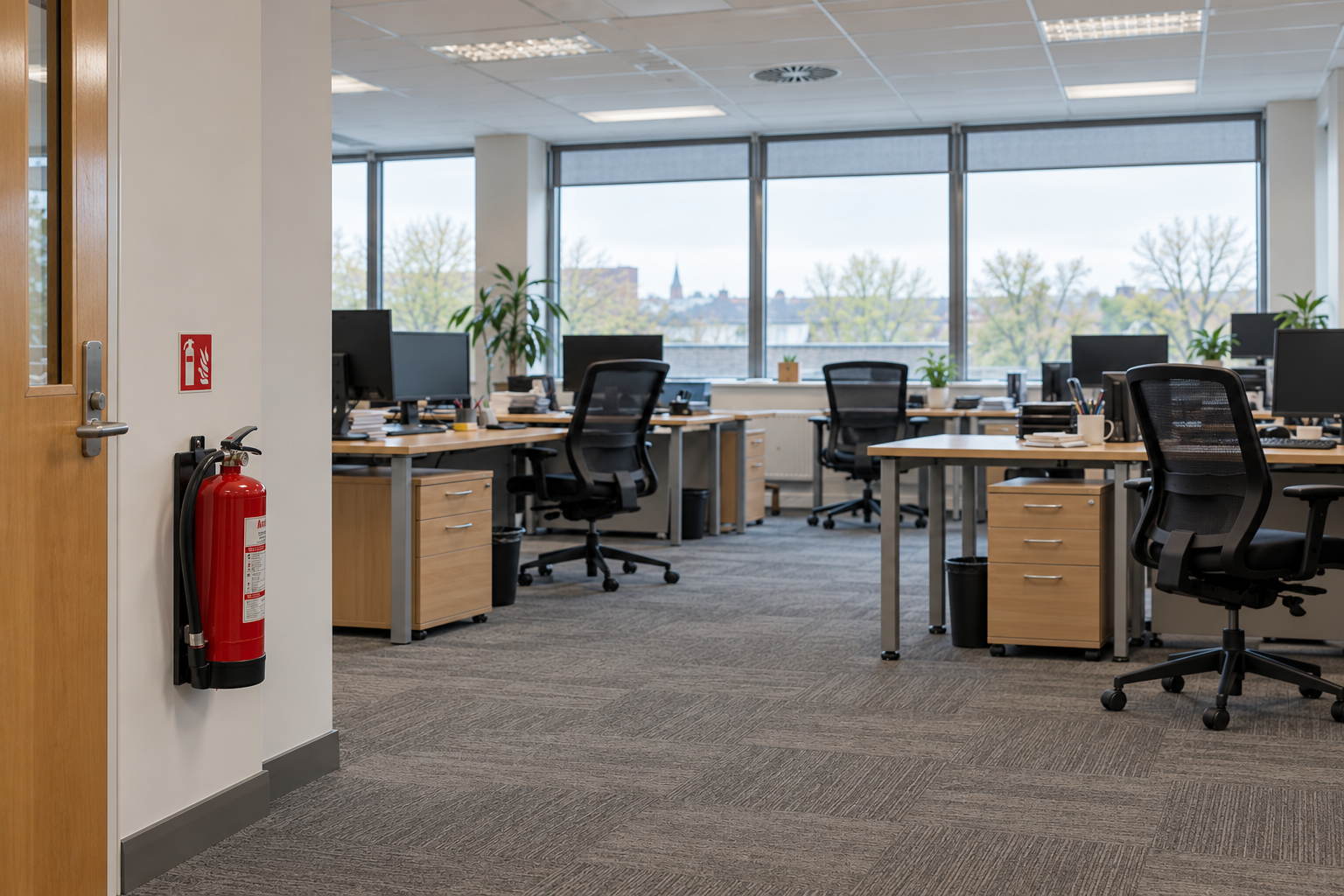
Office fire risks include faulty electrical equipment, overloaded extension leads, portable heaters, kitchen appliances, combustible waste and unsafe battery charging. Problems with escape routes, fire doors and warning systems can then make a fire more dangerous by delaying evacuation or allowing smoke to spread.
For employers, office managers and facilities teams, effective prevention means understanding how the workplace is used and keeping precautions working as circumstances change. This guide explains the main hazards, practical ways to reduce them and how to organise fire safety across an office building.
Why office fire safety needs regular attention
A fire needs a source of ignition, fuel and oxygen. Offices bring these together through everyday items: electrical equipment provides potential ignition sources, while paper, packaging, furniture and fittings provide material that can burn. Preventive measures should keep heat and combustible materials apart and address faults before they develop into an emergency.
The position of a hazard also matters. A damaged charger beside an otherwise clear desk presents a different situation from one surrounded by cardboard near the only exit. Assessing office fire risks means considering both the chance of a fire starting and what could happen to the people nearby.
Fire safety therefore needs to cover the whole workplace, including meeting rooms, storage areas, kitchens, plant cupboards and shared circulation spaces. Changes that appear minor, such as relocating a printer or introducing a new appliance, deserve attention when they affect existing precautions.
Common causes of office fires
Faulty electrical equipment and damaged wiring
Computers, monitors, printers and other office appliances can become hazardous when plugs, cables or internal components are damaged. Equipment may still appear to work even when it is no longer safe.
Staff should know how to recognise and report visible warning signs, including:
- Frayed cables or exposed internal wires.
- Cracked plugs or damaged appliance casings.
- Scorch marks or discolouration around electrical connections.
- Damaged cables repaired with tape.
- Leads trapped beneath furniture or repeatedly pulled tight.
Take suspect equipment out of use and arrange a competent inspection. Staff should not improvise repairs or continue using an appliance because a replacement is inconvenient.
The fixed electrical installation also needs appropriate attention. Repeated problems with a particular socket or circuit should be investigated rather than worked around by moving appliances elsewhere. Position cables to prevent damage during cleaning, desk adjustments and everyday movement. HSE
Overloaded sockets and extension leads
An extension lead has a maximum current rating. The number of available sockets does not tell you how much equipment it can safely supply.
Risk can increase when an extension intended for desk equipment also powers appliances with higher electricity demands. A spare outlet can look like a convenient solution even though the combined load is unsuitable.
Never connect one extension lead to another, and do not exceed the rating stated on the equipment. Cable reels should be fully unwound during use in accordance with their instructions. Where the office regularly needs multiple extensions, arrange a review of the socket provision with a qualified electrician.
This is especially relevant after desk moves or an increase in staff numbers. A layout that worked for two workstations may be unsuitable once extra monitors, chargers and other devices have been added.
Portable heaters and other heat sources
A portable heater under a desk can end up close to a waste bin, a coat, loose paper or upholstered furniture. These positions can obstruct airflow and bring combustible materials close to heat.
Set clear rules for introducing heaters into the office. Approved equipment should be suitable for the location, used according to its instructions and positioned with the required clearance. Staff should never cover heaters or use them to dry clothing.
Keep heaters stable, protect them from being knocked over and switch them off when the area is unattended. Check that the proposed electrical supply is suitable before use.
If staff regularly bring in personal heaters, investigate the underlying heating problem. Addressing an uncomfortable workspace makes it easier to control the additional appliances being used.
Kitchens and staff break areas
An office kitchenette can contain several potential ignition sources in a small space. Toasters, microwaves and air fryers need suitable positioning, cleaning and safe use, even when they are only used for snacks or lunch.
Keep appliance vents clear and follow the manufacturer’s instructions on clearances. Remove accumulated crumbs, grease and food residue, and keep packaging and paper towels away from hot surfaces. Use microwave-safe containers and avoid leaving food heating while returning to a meeting or taking a call.
Give someone responsibility for the shared kitchen’s condition. Without clear ownership, a damaged appliance or a build-up of grease can remain unnoticed between cleaning visits.
Switch off cooking equipment when finished, as appropriate to the appliance. Refrigerators and other equipment designed for continuous operation need their own suitable arrangements.
Where an office includes a staffed catering kitchen, assess its cooking equipment, extraction and protection measures separately. A small staff kitchenette and a kitchen producing meals throughout the day have different operational risks.
Lithium-ion batteries and charging equipment
Laptops, mobile phones, power banks and other rechargeable devices need sensible charging arrangements. Use compatible chargers from reputable suppliers, follow the manufacturer’s instructions and keep devices on suitable hard surfaces with adequate ventilation. Avoid charging beneath papers, on upholstered seating or inside a bag.
E-bikes and e-scooters require particular consideration when staff bring them to work. Include their storage and charging in the fire risk assessment, and decide where these activities can safely take place. A convenient socket beside a stairway or reception exit is not a suitable reason to charge there.
The arrangements should account for battery condition, the equipment being used, the charging location and who will be present. Keep escape routes clear and protected, and seek specialist advice where suitable facilities are needed.
Swelling, unusual heat, leakage, hissing or a strong chemical smell can indicate a failing battery. Stop using suspect equipment and follow the manufacturer’s advice on safe handling. If a battery smokes or catches fire, leave immediately, raise the alarm and call 999. Do not try to move it or tackle the fire yourself.
Paper, packaging and combustible storage
Paper records, stationery, cardboard boxes and soft furnishings can provide fuel for a fire. The problem becomes more serious when combustible materials accumulate close to electrical equipment, heaters or lighting.
Provide proper storage for deliveries and archives, and remove waste regularly. Include rarely visited cupboards in housekeeping checks, particularly during office clear-outs or equipment upgrades.
IT and plant areas should not become overflow storage. Boxes around equipment can obstruct ventilation and access, while spare furniture can interfere with the intended use of the space. Keep the clearances specified for the equipment.
Office fit-outs also deserve attention. Wall coverings, acoustic products and decorative materials should be assessed for their location and contribution to fire spread. Appearance and convenience should not be the only considerations when choosing them.
Smoking materials and naked flames
Smoking outside does not remove the need for fire precautions. Discarded cigarettes can ignite waste, and ash can remain hot after someone thinks it has gone out.
Make the smoking arrangements clear to employees, contractors and visitors. Provide suitable receptacles made from materials that will not burn, and establish a safe emptying routine. Cigarettes should be fully extinguished, with smoking areas kept away from combustible waste and storage.
Include vaping equipment in the office’s charging and disposal arrangements. Vapes and batteries should not go into ordinary waste bins; provide information on suitable recycling or take-back routes.
For office celebrations or decorative displays, choosing flameless alternatives avoids introducing an unnecessary naked flame.
Flammable cleaning and maintenance products
Some cleaning products, aerosols, paints, adhesives and solvents can contribute to fire risk. Their presence may be easy to overlook when they are kept in a cupboard or brought in by a contractor.
Check product labels and safety data sheets to understand the hazards and storage requirements. Keep quantities proportionate to the work, close containers after use and store incompatible products separately as required by their instructions and assessment.
Choose less hazardous alternatives where practical. Make sure cleaning and maintenance teams know where products can be stored and how to report damaged containers or spills.
Where dangerous substances are present, employers must assess and control the relevant risks under the Dangerous Substances and Explosive Atmospheres Regulations 2002, commonly called DSEAR. This should be considered alongside the office’s general fire precautions.
Maintenance work and refurbishment
Contractors can introduce fire risks that are absent during normal office activity. Welding, grinding, soldering and other work involving flames, heat or sparks can ignite nearby materials, including material concealed within the building.
Assess the work before it starts. Consider whether a method without heat or sparks is practical, and agree suitable controls where hot work is necessary. These may include removing or protecting combustible materials, providing appropriate firefighting equipment, a permit-to-work procedure and fire-watch arrangements appropriate to the task.
The work area also needs to remain safe for other occupants. Keep temporary cables, packaging and tools away from escape routes, and coordinate the work with building management.
Any necessary changes to alarm coverage or other protection during works require planned temporary precautions. Responsibility for restoring systems afterwards should be explicit.
Arson and external security
Deliberate fires should be considered alongside accidental ignition. Accessible waste containers, insecure service areas and combustible material outside the building can create opportunities for fire-setting.
Review perimeter access, external lighting and the way deliveries and waste are managed. Keep unauthorised people out of staff-only areas, and make sure employees know how to report suspicious activity.
An agreed closing procedure should cover external security, internal doors and the condition of storage and waste areas. Check who carries out these tasks when the usual office manager is absent.
Security arrangements must also work with the emergency plan. Securing a building should never leave people who are still inside unable to escape.
Conditions that make an office fire more dangerous
Blocked escape routes and difficult exits
A corridor does not need to be completely blocked to become a problem. A delivery trolley, spare chair or stack of archive boxes can narrow the route and slow people down, particularly where someone needs assistance.
Keep the full escape route usable, from workstations through corridors and stairways to a place of safety. Check external routes as well as indoor ones. An exit opening into a yard obstructed by bins or parked vehicles may not provide the escape expected.
Emergency exits must be readily usable while people are in the building. Staff should understand any door-release arrangements, and routes should have suitable signs and emergency lighting where required.
Consider visitors who do not know the layout and people who may have difficulty using stairs or responding to an alarm. These needs should influence the plan before an emergency occurs.
Damaged fire doors and gaps in fire separation
Fire doors form part of the protection that limits the spread of fire and smoke and helps keep escape routes usable. Their effectiveness depends on the complete assembly, including the door, frame, seals, hinges and closing mechanism.
Check that doors close correctly and report damage, missing components or signs of tampering. A door that catches on the floor or does not shut into its frame needs attention. Do not wedge fire doors open or disconnect their closers. Arrange inspections and repairs by people with the relevant competence.
Fire-resisting walls and floors also need to retain their integrity. New cabling, pipework or ductwork can leave openings through which smoke and fire may spread if the penetrations are not correctly protected.
Include fire stopping in the scope of office alterations. Appropriate systems need to be selected and installed for the actual construction and services involved. Passive fire protection surveys and remedial work can help identify and address these weaknesses.
Unreliable alarms and unresolved false alarms
Fire detection and warning arrangements need to suit the premises, occupancy and emergency strategy. A system that has not been maintained, or no longer reflects the layout, may not give people the warning they need.
Consider alarm coverage when new partitions, enclosed meeting rooms or pods are installed. Changes to the way a space is used may require a review by the alarm specialist.
Repeated false alarms also need investigation. If employees become accustomed to dismissing an alarm, their response to a real fire may be delayed. Record the circumstances and work with the maintainer to address the cause.
Never treat disabling a detector as a routine solution to unwanted activations. Where any part of the system is impaired or temporarily isolated, obtain competent advice on interim precautions and ensure that restoration is managed.
Unsuitable or poorly maintained firefighting equipment
Fire extinguishers should be selected for the hazards present, positioned appropriately and kept accessible. The risks associated with ordinary combustible materials, live electrical equipment and cooking oils are different.
Have the type, number and location of extinguishers assessed for the premises. Ensure staff understand the site’s policy on their use, and provide suitable training for anyone expected to operate them. An extinguisher should never become a doorstop or disappear behind storage.
Some premises may also need a review of fixed protection for particular areas, such as server rooms or commercial kitchens. The suitability of a fire suppression system depends on the hazards, occupancy, building design and operational requirements. Obtain specialist advice before selecting a system.
Who is responsible for office fire safety?
In England and Wales, the Regulatory Reform (Fire Safety) Order 2005 places duties on the responsible person. In a workplace, the employer has responsibilities, while owners, landlords and others with control of the premises may also have duties.
These can overlap in a shared office building. A landlord or managing agent may manage common stairs and shared systems, while the employer remains responsible for precautions and working practices within its control. The parties must cooperate and coordinate their arrangements.
Agree who maintains each system, checks shared routes, communicates changes and manages evacuation. A lease or service contract can help clarify practical tasks, but renting an office does not remove the employer’s own responsibilities.
Scotland and Northern Ireland have separate fire-safety legislation; the legal framework described here applies to England and Wales.
The fire risk assessment must be recorded in full, together with the premises’ fire safety arrangements, regardless of employee numbers. Since 1 October 2023, the previous exemptions from recording based on factors such as having fewer than five employees no longer apply. Record who carried out or reviewed the assessment, including their organisation where applicable.
How to manage office fire risks in practice
Start with a suitable fire risk assessment
A fire risk assessment should reflect the actual premises, activities and people using them. It should identify hazards, consider who could be harmed, evaluate the existing precautions and establish the measures needed to reduce risk.
Include employees, visitors, cleaners, contractors and anyone who may need additional assistance. Consider fire detection, escape routes, firefighting equipment, dangerous substances, emergency planning and training together.
The assessment should produce actions that can be implemented. Give each action an owner, a suitable timescale and a way to confirm completion. Urgent risks need prompt attention; recording a defect without addressing it does not protect anyone.
Review the assessment regularly and whenever changes or new information suggest it may no longer be valid. If the office lacks the expertise or time to complete the assessment properly, obtain support from a competent person.
Account for changes in occupancy and layout
Fire-safety arrangements need to work for the people actually present. A plan that depends on particular employees may need adjusting when attendance varies.
For a hybrid office, practical questions include:
- Are enough trained people available on each working day?
- Who supports evacuation when the usual fire warden is away?
- How are visitors and contractors included?
- What arrangements cover early arrivals, late working and cleaning shifts?
These questions apply the wider need for suitable staffing, training and escape planning to the way the office operates. Review them with the people who manage the building.
Treat an office reconfiguration as a prompt to check fire precautions. New desks, partitions, storage or appliances may affect electrical demand, alarm coverage, routes or access to safety equipment. Build that review into the change process so it happens before the revised space is occupied.
Train staff for the building they use
Staff training should explain how to prevent fires, report hazards, raise the alarm and respond to the building’s warning signals. Staff need to understand the escape routes, assembly arrangements and any specific responsibilities they have.
Make the instruction practical. Show new starters the routes and exits they may need, including alternatives to their usual entrance. Include relevant arrangements for contractors, reception teams, cleaners and people working outside normal hours.
Fire wardens need training that matches their assigned duties. Everyone else still needs enough information to respond appropriately; appointing wardens does not make fire safety their responsibility alone.
GOV.UK recommends at least one fire drill each year and recording the results. Use drills to identify difficulties, then follow up with changes to the arrangements or additional training where needed.
Plan evacuation assistance in advance
Consider people who may have difficulty hearing an alarm, understanding instructions, moving quickly or using stairs. Discuss individual requirements sensitively and agree suitable assistance, including a personal emergency evacuation plan where appropriate.
Check that the people, equipment and arrangements needed will be available whenever the person is present. This is particularly relevant when working patterns vary or support normally comes from one colleague.
The emergency plan should explain how occupants reach safety and who carries out each task. Do not assume the fire and rescue service will provide the assistance that the workplace should have planned.
Maintain equipment and follow up defects
Set out who carries out routine checks and who arranges specialist servicing. The programme should cover the fire-safety measures installed in the building, including alarms, emergency lighting, extinguishers and fire doors.
Use appropriate testing and maintenance intervals for each system, informed by the fire risk assessment, relevant standards, manufacturer instructions and competent advice.
Keep records of checks, servicing, faults and remedial work. A recurring fault deserves investigation, particularly if it affects an escape route or a system relied on by the emergency plan. Make sure someone is responsible for confirming that repairs have been completed.
For shared systems, agree how the office receives information about faults, planned works and restoration. Otherwise, a tenant may continue operating without knowing that a precaution it relies on has been affected.
Make checks part of the working day
A short, consistent check can identify changes that occur between formal inspections. It should cover the conditions staff are most likely to alter: escape routes, storage, kitchen use, charging equipment and access to safety equipment.
Keep the process proportionate to the workplace. For example, assign responsibility for checking deliveries have been moved to suitable storage and for reporting new equipment brought onto the premises.
Make reporting straightforward, with a clear contact and a route for escalating unresolved concerns. Encourage staff to report near misses and changes in conditions, as well as obvious defects.
Routine checks support the fire risk assessment and maintenance programme. A generic checklist alone does not amount to a suitable assessment of the office.
What to do if a fire starts in the office
If the alarm sounds, follow the building’s emergency procedure immediately. If you discover a fire, raise the alarm and leave the affected area by a safe route. The key actions are:
- Raise the alarm using the agreed method, provided this can be done safely.
- Leave by a safe escape route, closing doors behind you where safe.
- Call 999 from a safe place and give the building’s address and relevant information.
- Go to the assembly point and report concerns about anyone who may still be inside.
- Stay out until the emergency services say it is safe to return.
Do not delay escape to collect belongings. Use a lift only where it is specifically designated for evacuation and its use forms part of the building’s planned procedure.
Only consider using an extinguisher on a small fire at its earliest stage, after the alarm has been raised, if you are appropriately trained, the equipment is suitable and the site’s procedure permits it. Keep a clear escape route and withdraw immediately if conditions worsen. Never delay evacuation to fight a fire.
FAQs
Is annual PAT testing a legal requirement for offices?
There is no blanket legal requirement to PAT test every office appliance annually. Employers must maintain electrical equipment in a safe condition, but the approach and frequency should reflect the equipment, use and environment.
HSE explains that user checks, visual inspections and testing can each have a role. Some defects are visible, while others require testing to identify them. A suitable maintenance programme should address the actual risks and should not rely solely on a dated test label.
Can an office fire door ever be held open?
In suitable circumstances, a fire door may use a purpose-designed automatic hold-open or free-swing device that allows it to close when the fire alarm operates. This can help where doors are frequently used or accessibility needs make a conventional closer difficult.
The arrangement must be appropriate to the door, alarm system and building’s fire strategy, and requires assessment, correct installation and maintenance. Obtain competent advice before fitting one. A wedge or disconnected closer does not provide the same protection.
Reduce office fire risks with Thameside Fire Protection
Understanding the hazards in your office is the starting point for choosing practical improvements and keeping your precautions effective.
Thameside Fire Protection provides fire risk assessments for businesses, with site inspections and clear written recommendations. We can help you understand which issues need attention and plan the next steps for your premises.
Our services also include fire alarm installation and maintenance, fire extinguisher servicing, passive fire protection and workplace fire safety training. Thameside Fire Protection
Contact Thameside Fire Protection to discuss your office fire-safety requirements and request a quotation, or call 01268 597999.