
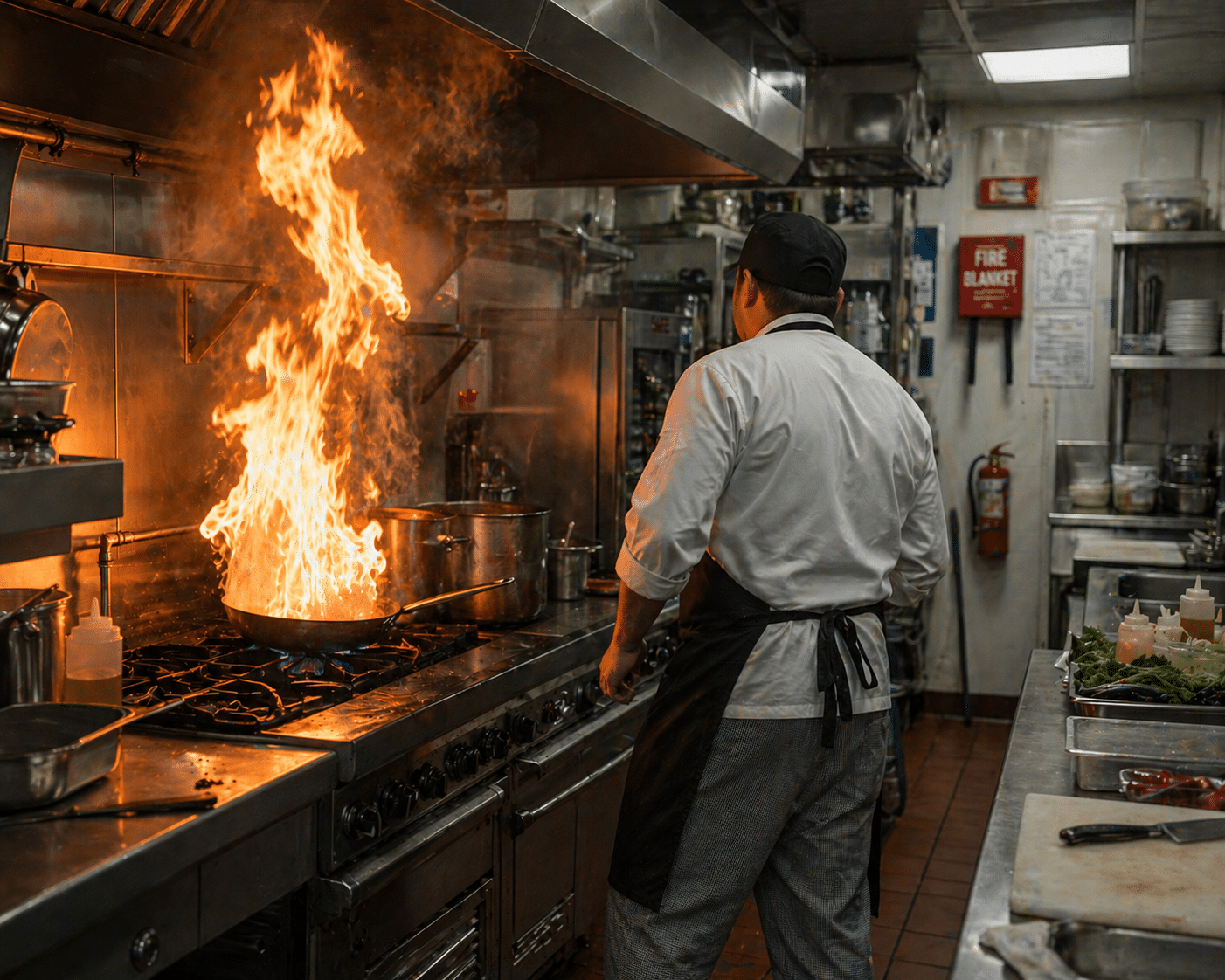
Fire poses a significant risk in hospitality settings. Hotels, restaurants, pubs, cafes and other hospitality venues bring together the conditions most associated with fire risk – commercial kitchens, large numbers of people, electrical systems running around the clock, and in many cases, overnight guests who may be asleep when a fire starts.
Understanding the most common causes of fire in the hospitality industry is the first step toward preventing them.
Commercial Kitchen Fires
The kitchen is the single highest-risk area in most hospitality venues. The combination of open flames, hot surfaces, cooking oils and fats, and a fast-paced working environment creates conditions where fire can start and spread quickly.
Cooking equipment and hot surfaces
Unattended cooking is one of the leading causes of kitchen fires across the hospitality industry. During busy service periods, equipment can be left running, temperatures can exceed safe limits, and staff may not notice warning signs until a fire has already taken hold.
Deep fat fryers present a particular risk. When cooking oil overheats, either because thermostat controls fail or the fryer is left unattended, it can reach its auto-ignition point and catch fire without any external ignition source. These fires are extremely difficult to extinguish without the correct equipment and should never be tackled with water.
Grills, ranges and solid-top ovens accumulate grease over time. Without regular and thorough cleaning, this build-up can ignite during normal cooking operations, leading to a grease fire that spreads rapidly across surfaces and through extraction systems.
Extraction and ventilation systems
Grease-laden vapour rises from cooking surfaces and is drawn into extraction canopies and ductwork. Over time, grease deposits accumulate inside ducting and, if not professionally cleaned at the recommended intervals, can catch fire — often carrying flames through the ductwork and into other parts of the building.
A ducting fire that reaches a roof void or travels between floors can turn a contained kitchen incident into a serious structural fire very quickly. Regular extraction cleaning by a competent contractor, with certificates retained as part of your fire safety records, is essential.
Electrical Fires
Electrical faults are among the most common causes of fire in commercial premises of all kinds, and hospitality venues are no exception. The electrical demand placed on hotels, restaurants and venues is substantial. Refrigeration, lighting, kitchen equipment, entertainment systems and heating all running continuously place significant strain on electrical infrastructure.
Faulty or ageing wiring
Wiring that is old, damaged or incorrectly installed can overheat and arc, igniting surrounding materials. In older hospitality buildings, many of which have been converted from residential or listed properties, wiring may not meet modern standards and may never have been formally assessed.
Overloaded circuits and extension leads
The use of extension leads and multi-socket adaptors to accommodate increasing numbers of devices is a common sight in back-of-house areas and guest rooms. Overloading circuits generates heat, which can degrade insulation and ultimately cause a fire. Hospitality venues should ensure sufficient sockets are installed to meet operational demand, rather than relying on temporary solutions.
Appliance faults and white goods
Refrigerators, dishwashers, tumble dryers and other large appliances are implicated in a significant number of commercial fires each year. Faulty motors, wiring defects and blocked vents can all cause appliances to overheat. Tumble dryers in laundry facilities pose a particular risk if lint filters are not regularly cleared, as lint is highly combustible.
Checking appliances against product recall registers and ensuring regular maintenance is carried out by a competent person significantly reduces this risk.
Arson
Arson is a notable cause of fire in the hospitality sector, particularly for venues with outdoor spaces, bin stores or areas that are accessible after hours. Waste stored close to buildings, unsecured outbuildings and poorly lit external areas all increase the risk of deliberate fire-setting.
Practical steps to reduce arson risk include keeping bin stores away from the main building and secured, ensuring external areas are well lit, and installing CCTV coverage of vulnerable areas.
Smoking
Despite restrictions on indoor smoking, smoking-related fires remain a risk in hospitality venues. Inadequately extinguished cigarettes discarded in external areas, particularly in planters, flower beds or near combustible outdoor furniture, can smoulder for hours before igniting.
Designated smoking areas should be equipped with appropriate, non-combustible receptacles, positioned away from the building and inspected regularly, particularly at the end of each trading day.
Candles and Decorative Lighting
Many hospitality venues use candles, tea lights and decorative lighting to create atmosphere. These introduce a naked flame risk that is easy to overlook in a risk assessment.
Unattended candles, candles placed too close to soft furnishings or floral arrangements, and tea lights that burn down into combustible holders are all realistic ignition scenarios. Battery-operated alternatives have improved significantly in quality and are worth considering in venues where atmosphere is a priority but fire risk needs to be minimised.
Fairy lights and decorative electrical lighting (particularly older sets or those left running overnight) can also overheat and ignite nearby materials.
Laundry Facilities
Hotels and larger hospitality venues operating on-site laundry facilities face a specific risk. High-temperature tumble dryers, particularly those processing linens with residual traces of body oils or cleaning products, can overheat. Lint accumulation is a primary factor. Filters should be cleaned after every cycle, and ducting inspected and cleaned regularly.
Laundry should never be left unattended in a dryer, and dryers should be switched off when not in use or when premises are unoccupied.
Heating Systems
Boilers, portable heaters and fixed heating systems can all be a source of ignition if poorly maintained or used incorrectly. Portable electric heaters used in back-of-house or staff areas are a particular concern, they are often placed too close to clothing, paper or other combustibles, and may be left running unattended.
Boilers and fixed heating systems should be serviced annually by a Gas Safe registered engineer, with records retained. Any faults should be reported and addressed promptly rather than left.
Human Error and Staff Behaviour
Across all of the above categories, human behaviour is a common thread. Unattended cooking, overloaded sockets, candles left burning and cigarettes not properly extinguished all come down to actions (or inactions) by people. This is why staff training is one of the most important fire prevention tools available to hospitality operators.
All staff should understand the fire risks specific to their role and their venue, know how to raise the alarm, and be familiar with evacuation procedures. Fire marshal training for designated staff, and regular fire drills, are a legal requirement under the Regulatory Reform (Fire Safety) Order 2005 for most commercial premises.
Your Legal Obligations
Under the Regulatory Reform (Fire Safety) Order 2005, the responsible person for a hospitality venue (typically the owner or manager) is legally required to carry out a suitable and sufficient fire risk assessment and act on its findings. This includes identifying fire hazards, reducing risks where possible, and putting in place appropriate fire safety measures.
Fire risk assessments should be reviewed regularly and updated whenever there is a significant change to the premises, its use, or the number of people present.
FAQs
What is the most common cause of fire in hotels?
Electrical faults and cooking equipment are consistently among the leading causes of fire in hotels. Electrical fires can originate in guest rooms, back-of-house areas or plant rooms, while cooking-related fires typically start in the kitchen. Arson and smoking-related fires are also significant contributors in the hotel sector.
What causes most restaurant fires?
The majority of restaurant fires originate in the kitchen, most commonly from cooking equipment and grease build-up in extraction systems. Deep fat fryers, grills and ranges are the most frequently implicated pieces of equipment. Regular cleaning of both cooking equipment and extraction ducting is the most effective preventative measure.
How can hospitality venues reduce the risk of fire in the kitchen?
Key measures include never leaving cooking equipment unattended, ensuring extraction systems are cleaned regularly by a competent contractor, maintaining cooking equipment in good working order, installing automatic fire suppression systems above cooking ranges, and ensuring staff are trained in how to respond to a kitchen fire safely.
Is a fire risk assessment a legal requirement for hospitality venues?
Yes. Under the Regulatory Reform (Fire Safety) Order 2005, a fire risk assessment is a legal requirement for virtually all non-domestic premises in England and Wales, including all hospitality venues. The responsible person must ensure the assessment is suitable, sufficient and kept up to date.
How often should extraction systems be cleaned in a commercial kitchen?
The frequency depends on the volume and type of cooking carried out. As a general guide, heavy-use kitchens such as those in hotels or busy restaurants should have extraction systems professionally cleaned every three months. Light-use kitchens may only require annual cleaning. TR19 guidance from BESA sets out the industry standard for extraction cleaning frequencies.
Can a tumble dryer cause a fire in a hotel laundry?
Yes. Tumble dryers are a known fire risk in commercial laundry settings. The primary causes are lint accumulation in filters and ducting, overheating due to poor maintenance, and linens processed with residual traces of oils or certain cleaning products. Filters should be cleaned after every cycle and ducting inspected regularly.
What fire safety training do hospitality staff need?
All staff should receive fire safety awareness training covering how to raise the alarm, evacuation procedures and their personal responsibilities. Designated fire marshals require more formal training, typically a half-day fire marshal course. Training should be refreshed regularly, annually is considered best practice, and records kept.
What should I do if a deep fat fryer catches fire?
Never use water on a fat fire – this will cause a violent steam explosion. If a deep fat fryer catches fire, turn off the heat source if it is safe to do so, use a wet chemical extinguisher (Class F) or a fire blanket to smother the flames, activate the fire alarm and evacuate. Only attempt to tackle a fire if you have been trained to do so and it is safe.
Fire Safety Support for Hospitality Businesses
At Thameside Fire Protection we work with hotels, restaurants and hospitality venues across the region to identify fire risks and put the right protections in place. From fire risk assessments to staff training and extinguisher servicing, we provide everything you need to keep your venue, your staff and your guests safe.
Find out about our fire protection services or get in touch to discuss your fire safety requirements.