
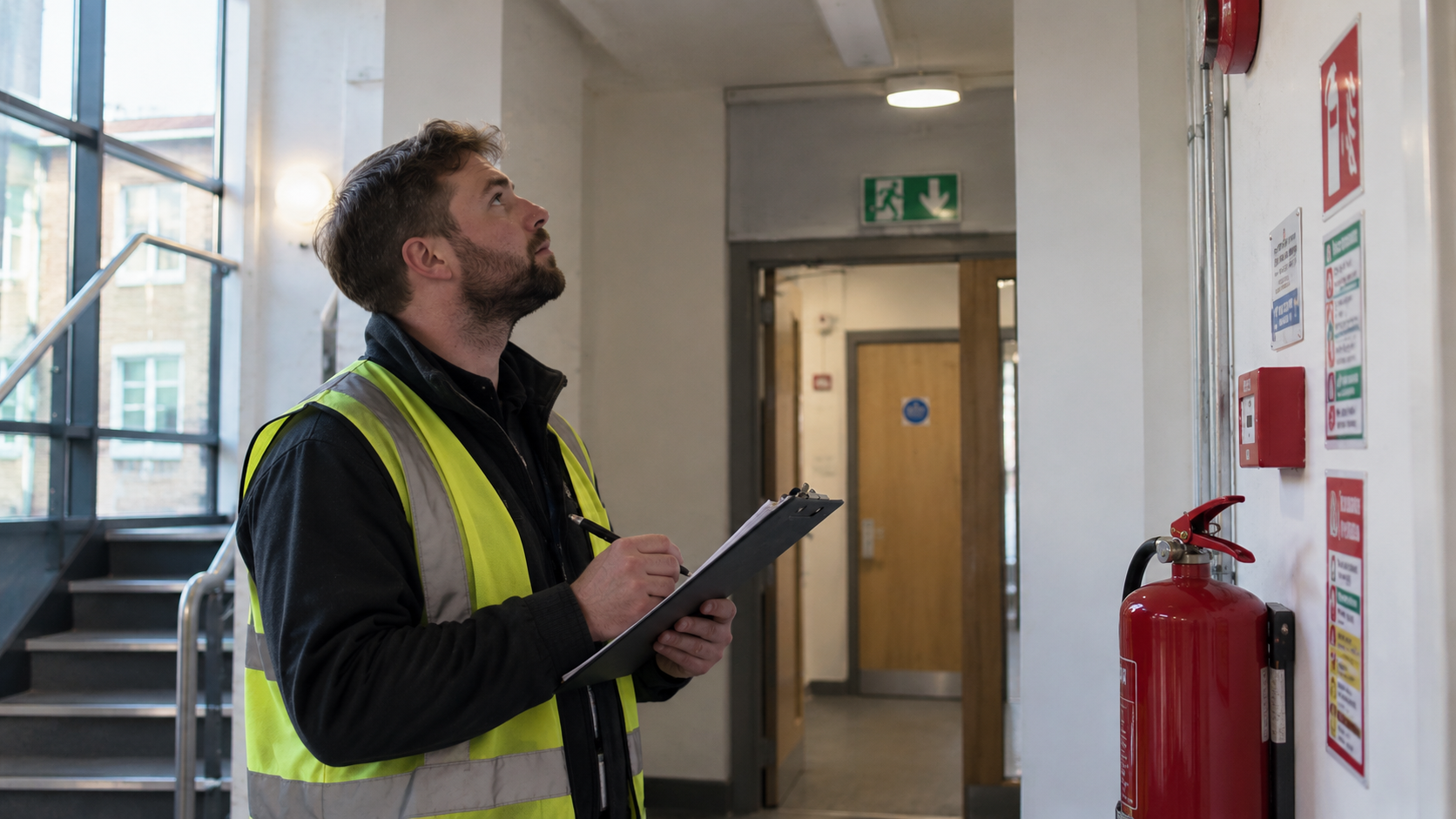
A fire risk assessment is a systematic examination of a building to identify potential fire hazards, evaluate the risks to people and determine what safety measures are needed. To perform a fire risk assessment, you must identify fire hazards, establish who could be at risk, evaluate and reduce those risks, document your findings and regularly review the assessment.
Fire risk assessments are a legal requirement for most commercial and non-domestic premises in the UK. This guide explains the five key steps involved, what to look for during an inspection, how to document your findings and when to consider using a professional fire risk assessor.
What is a Fire Risk Assessment?
A fire risk assessment is a structured inspection and evaluation of a premises, its activities and the people who use it. Its purpose is to identify how a fire could start, assess the potential consequences and establish suitable precautions to prevent fires and protect people if one occurs.
An effective assessment should consider both fire prevention and fire protection. This means looking at how to reduce the likelihood of a fire starting, as well as ensuring that suitable arrangements are in place to detect fires, limit their spread and allow occupants to evacuate safely.
Fire risk assessments are relevant to many different types of premises, including:
- Offices and commercial buildings
- Shops and retail premises
- Factories and warehouses
- Restaurants, hotels and hospitality venues
- Schools, nurseries and educational facilities
- Healthcare facilities and care homes
- Communal areas of residential buildings
- Houses in multiple occupation (HMOs), where relevant fire safety duties apply
- Public buildings and community venues
The assessment must reflect the specific characteristics of the building. For example, a small office with a handful of employees will have very different hazards and evacuation requirements from a multi-storey hotel or industrial warehouse.
Who is Responsible for Carrying Out a Fire Risk Assessment?
In England and Wales, the Regulatory Reform (Fire Safety) Order 2005 places fire safety duties on the responsible person.
Depending on the premises and how it is used, the responsible person may be:
- An employer or business owner
- A landlord or building owner
- A managing agent or facilities manager
- An occupier with control over the premises
- Another person or organisation with relevant control over fire safety arrangements
In shared or multi-occupied buildings, several parties may have responsibilities. They must cooperate and coordinate their fire safety arrangements, particularly where they share escape routes, fire protection systems or communal spaces.
The Fire Safety Order generally applies to non-domestic premises, including relevant communal areas of residential buildings, rather than the interior of an ordinary private home.
Scotland and Northern Ireland have separate fire safety legislation, although the underlying principles of identifying hazards, assessing risks and taking preventative action are similar.
The responsible person can carry out the assessment themselves if they have sufficient knowledge and competence. Alternatively, they can appoint a suitably competent fire risk assessor.
Appointing a professional does not transfer the responsible person’s legal duties. They remain accountable for ensuring the assessment is suitable and sufficient and that the necessary fire safety measures are implemented.
Preparing to Carry Out a Fire Risk Assessment
Before inspecting the premises, gather the information needed to understand how the building operates and what fire safety measures are already in place.
This preparation can make the assessment more thorough and help identify issues that might otherwise be overlooked.
Useful information includes:
- Building plans and layout: The number of floors, rooms, staircases, entrances, exits and escape routes.
- Occupancy information: How many people normally use the building, when they are present and whether anyone may need assistance evacuating.
- Building activities: The work being carried out, including processes involving heat, machinery or combustible materials.
- Fire safety equipment: Details of alarms, emergency lighting, fire extinguishers, fire doors and other existing protection measures.
- Maintenance records: Inspection, servicing and testing records for relevant fire safety systems.
- Previous assessments: Existing fire risk assessments, recommendations and records of completed remedial work.
- Incident history: Previous fires, false alarms, near misses and other relevant safety concerns.
Speak to employees, managers, maintenance staff and other people familiar with the building. They may be aware of hazards that are not immediately obvious during a site inspection.
You should also establish the scope of the assessment, including which parts of the premises are covered and whether any additional specialist inspections may be required.
How to Perform a Fire Risk Assessment
The UK government’s fire safety guidance outlines five principal steps for carrying out a fire risk assessment.
These steps provide a structured approach to identifying hazards, protecting people and maintaining appropriate fire safety arrangements.
Step 1: Identify Fire Hazards
Begin by inspecting the premises to identify anything that could cause or contribute to a fire.
A fire needs three elements to start and continue burning:
- Ignition: A source of heat, flame or spark.
- Fuel: Material that can burn.
- Oxygen: Usually supplied by the surrounding air, although some processes or substances can introduce additional oxygen.
Together, these elements form the fire triangle.
Identifying where ignition sources and combustible materials could come into contact is a fundamental part of assessing fire risk.
Sources of ignition
Potential ignition sources include:
- Electrical equipment, damaged wiring and overloaded sockets
- Portable heaters and heating systems
- Cooking equipment and commercial kitchen appliances
- Smoking materials
- Welding, grinding and other hot work
- Machinery that produces heat or friction
- Battery charging equipment
- Naked flames and other sources of heat
Inspect equipment and consider whether suitable maintenance, operating procedures and other precautions are in place.
For example, portable heaters positioned close to combustible materials could create an avoidable fire hazard.
Sources of fuel
Next, identify materials that could ignite or contribute to the spread of a fire.
Common examples include:
- Paper, cardboard and packaging
- Furniture, fabrics and furnishings
- Flammable liquids, solvents and chemicals
- Waste materials and rubbish
- Wood, plastics and stored stock
- Combustible dust
- Gas cylinders and other fuel supplies
Consider both the materials themselves and how they are stored.
A warehouse containing substantial quantities of cardboard packaging, for example, may require particular attention to storage arrangements, housekeeping and separation from potential ignition sources.
Sources of oxygen
Oxygen is naturally present in the air, but certain equipment and activities can increase its availability.
Potential considerations include:
- Oxygen cylinders
- Medical oxygen systems
- Industrial processes using oxygen
- Oxidising chemicals
- Ventilation arrangements that could affect fire development
Where oxygen-enriched environments or oxidising substances are present, additional specialist precautions may be necessary.
The objective of this first step is to build a clear picture of how fires could start and what might allow them to spread.
Step 2: Identify People at Risk
Once you have identified the hazards, establish who could be affected if a fire occurred.
This includes everyone who might reasonably be present in or around the building, not just permanent employees.
People to consider include:
- Employees and managers
- Customers and visitors
- Contractors and maintenance workers
- Temporary and seasonal staff
- Cleaners, security staff and lone workers
- Residents and overnight guests
- People in neighbouring or connected premises
Particular attention should be given to people who might have difficulty recognising a fire alarm, responding promptly or evacuating without assistance.
This may include people with disabilities, reduced mobility, sensory impairments or other circumstances affecting their ability to escape safely.
Consider where these individuals may be located, the escape routes available to them and whether suitable assistance or evacuation arrangements are necessary.
Consider occupancy and working patterns
Risk can vary considerably depending on when and how a building is occupied.
For example:
- A warehouse may have only a few employees working overnight.
- A hotel may contain guests who are asleep and unfamiliar with the building.
- A shop may become crowded during busy trading periods.
- A workplace may have contractors working in isolated areas.
Your assessment should consider these different scenarios rather than focusing exclusively on normal daytime operations.
Step 3: Evaluate, Remove or Reduce Fire Risks
Having identified the hazards and people who could be affected, you must evaluate the risks and determine what precautions are needed.
This involves considering both the likelihood of a fire occurring and the potential consequences if one does.
A risk may be particularly serious where there are significant ignition sources, large quantities of combustible materials, inadequate escape arrangements or occupants who may have difficulty evacuating.
The priority should be to eliminate avoidable hazards wherever reasonably practicable, before relying on measures that reduce their consequences.
Reduce the likelihood of a fire
Practical fire prevention measures might include:
- Removing unnecessary combustible materials
- Keeping flammable substances away from ignition sources
- Ensuring electrical equipment is appropriately maintained
- Introducing safe storage arrangements for dangerous substances
- Keeping work areas clean and free from excessive waste
- Implementing appropriate controls for hot work
- Managing smoking areas safely
- Maintaining heating, cooking and industrial equipment
For example, if combustible packaging is stored beside electrical equipment, relocating the materials could significantly reduce the potential for a fire.
Assess fire detection and alarm systems
Check whether the premises have suitable arrangements for detecting fires and alerting occupants.
Consider:
- Whether the existing fire detection and alarm system is appropriate for the building
- Whether alarms can be heard or otherwise recognised throughout the premises
- Whether appropriate provision exists for occupants with hearing impairments
- Whether detection and warning equipment is regularly tested and maintained
- Whether staff know how to raise the alarm
The appropriate system will depend on the building’s layout, use, occupancy and level of risk.
Inspect emergency exits and escape routes
Escape routes are among the most important elements of a fire risk assessment.
Check whether:
- Sufficient exits and escape routes are available
- Routes are suitable for the building’s occupancy and layout
- Escape routes and exits are unobstructed
- Exit doors can be opened quickly and easily in an emergency
- Escape routes are adequately protected from fire and smoke
- Exit signs and emergency lighting are appropriate
- Occupants can reach a place of safety
- Arrangements exist for people who need assistance evacuating
For example, an emergency exit blocked by stored materials should be addressed immediately rather than left until the next scheduled inspection.
Examine fire doors and compartmentation
Fire doors and fire-resisting construction can help limit the spread of fire and smoke, protecting escape routes and allowing occupants more time to evacuate.
The assessment should consider whether:
- Fire doors are in suitable condition
- Doors close properly and are not wedged open
- Relevant seals, glazing and other components appear intact
- Walls, ceilings and floors provide the necessary fire separation
- Service penetrations have appropriate fire stopping
- Alterations to the building may have compromised compartmentation
Where defects or uncertainty are identified, further specialist inspection may be required.
Check firefighting equipment
Assess whether suitable firefighting equipment is available and appropriately positioned.
This may include:
- Portable fire extinguishers
- Fire blankets
- Hose reels, where appropriate
- Sprinkler systems
- Other fixed fire suppression equipment
Check relevant maintenance records and whether staff expected to use equipment have received suitable training.
Firefighting arrangements must reflect the premises and its specific hazards. Employees should never be expected to tackle a fire where doing so would put them at risk.
Step 4: Record Findings, Prepare an Emergency Plan and Provide Training
Once the hazards and necessary precautions have been identified, the next step is to document the assessment and establish how fire safety will be managed.
Record your fire risk assessment findings
In England and Wales, amendments to the Fire Safety Order that came into force on 1 October 2023 require responsible persons to record their fire risk assessments in full, regardless of the number of employees.
The written assessment should provide a clear account of:
- The premises being assessed
- The date and scope of the assessment
- Who carried out the assessment
- The fire hazards identified
- The people who could be at risk
- Existing fire prevention and protection measures
- The assessment of the risks
- Any deficiencies or concerns
- Recommended corrective actions
- Responsibilities and timescales for completing those actions
A prioritised action plan is particularly useful for ensuring that recommendations are implemented.
For example:
| Finding | Recommended action | Priority |
|---|---|---|
| Combustible materials stored near electrical equipment | Relocate materials to a suitable storage area | High |
| Fire door fails to close correctly | Arrange inspection and repair by a competent person | High |
| Emergency lighting maintenance records are incomplete | Verify servicing arrangements and update records | Medium |
| Fire safety information is outdated | Review and update staff instructions | Medium |
These are illustrative findings. Actual risk ratings and deadlines should reflect the circumstances of the premises.
An assessment should not simply identify shortcomings. It should establish a practical plan for addressing them, with clear ownership and appropriate timescales.
Create an emergency evacuation plan
An emergency plan should explain what occupants need to do if a fire occurs.
Depending on the building, this may include:
- How to raise the alarm
- How occupants will be warned
- The evacuation procedure and designated escape routes
- The location of assembly points
- Responsibilities for fire wardens or other designated personnel
- Procedures for assisting people who need help evacuating
- How emergency services will be contacted
- Arrangements for accounting for occupants after evacuation
- Contingency measures if important fire safety systems are unavailable
The plan should be appropriate to the building’s use and level of risk.
Where a building has multiple occupants or responsible persons, their emergency procedures should be appropriately coordinated.
Provide staff information and training
Employees need to understand the fire hazards associated with their workplace and the actions they should take in an emergency.
Training should cover relevant matters such as:
- Fire prevention procedures
- Recognising and reporting hazards
- Raising the alarm
- Following evacuation procedures
- Using escape routes safely
- The location of assembly points
- Individual responsibilities during an emergency
Additional instruction may be necessary for fire wardens and employees with particular duties.
Fire drills should be carried out at appropriate intervals to help test evacuation arrangements and identify potential weaknesses.
Step 5: Review and Update the Fire Risk Assessment
A fire risk assessment is not a one-off exercise.
Buildings, working practices and occupancy can change over time, potentially introducing new hazards or affecting existing fire precautions.
The assessment should therefore be reviewed regularly and updated whenever there is reason to believe it is no longer valid.
Examples of circumstances that may require a review include:
- Significant building alterations or refurbishment
- Changes to the building’s use or layout
- An increase in occupancy
- New machinery, equipment or work processes
- Changes to the storage or use of combustible materials
- Changes to evacuation arrangements
- A fire or near-miss incident
- Identification of previously unrecognised hazards
- Deterioration or alteration of fire protection measures
How often should a fire risk assessment be reviewed?
There is no universal legal requirement under the Fire Safety Order to carry out a completely new fire risk assessment every 12 months.
The requirement is to review the assessment regularly and whenever relevant circumstances change.
For smaller, relatively straightforward premises, an annual review is commonly regarded as good practice. More complex or higher-risk environments may need more frequent attention.
A review does not necessarily mean repeating the entire assessment from scratch. Where circumstances remain unchanged, it may involve checking that the previous findings are still accurate, recommended improvements have been completed and existing precautions remain effective.
The appropriate frequency should be determined by the characteristics and risks of the premises.
Common Mistakes to Avoid When Carrying Out a Fire Risk Assessment
Even when a fire risk assessment has been completed, overlooking important details can leave people exposed to avoidable risks.
Some common mistakes include:
Using a generic checklist without considering the building
Templates can provide useful prompts, but they cannot replace an assessment of the premises and its particular hazards.
An assessment for a commercial kitchen, for example, needs to consider risks that would not normally arise in a standard office.
Overlooking less frequently used areas
Store rooms, plant rooms, basements, roof spaces and external storage areas can contain significant hazards.
These areas should be included wherever relevant to the assessment’s scope.
Focusing only on fire extinguishers and alarms
Fire risk assessment involves much more than checking whether fire safety equipment is present.
The suitability of escape routes, fire compartmentation, building occupancy, housekeeping, staff procedures and other precautions must also be considered.
Failing to consider people who need evacuation assistance
A building may have suitable emergency exits but still present considerable risks to occupants who cannot use them independently.
Evacuation arrangements must take account of the people who actually use the premises.
Not acting on the assessment findings
Completing the assessment is only part of the process.
If serious hazards have been identified, appropriate action must be taken to address them. Leaving recommendations unresolved can undermine the effectiveness of the entire exercise.
Not reviewing the assessment after building changes
Changes to a building or how it operates can make an existing assessment inaccurate.
Fire safety arrangements should be reviewed whenever significant modifications affect the premises or its occupants.
Can You Carry Out a Fire Risk Assessment Yourself?
It is possible to carry out your own fire risk assessment, provided you have the knowledge, skills and experience necessary to assess the premises properly.
For a small, straightforward workplace with relatively limited hazards, the responsible person may be able to complete the assessment using official guidance and appropriate checklists.
However, the level of competence required increases with the building’s complexity and the risks involved.
A professional assessment may be particularly appropriate for:
- Large or multi-storey buildings
- Factories and industrial premises
- Hotels and buildings providing sleeping accommodation
- Healthcare and residential care facilities
- Buildings with complex evacuation arrangements
- Premises containing dangerous substances
- Buildings with complex fire protection systems
- Multi-occupied or otherwise complex residential premises
An experienced assessor can help identify hazards, evaluate existing fire precautions and determine whether additional specialist investigations may be required.
When appointing a professional, consider their relevant qualifications, experience, professional registrations or certifications, and suitability for the particular type of premises.
The responsible person should also ensure that the assessment results in clear, practical recommendations rather than simply a completed checklist.
What Happens After a Fire Risk Assessment?
Once the assessment is complete, review the findings carefully and establish how any identified deficiencies will be addressed.
The first priority should be any issues that present an immediate or serious risk to occupants.
Other improvements should be scheduled according to their assessed urgency, with clear responsibilities and appropriate deadlines.
Depending on the findings, the necessary measures could include:
- Repairing or replacing defective fire doors
- Improving fire detection and alarm arrangements
- Upgrading emergency lighting
- Providing suitable firefighting equipment
- Improving fire stopping and compartmentation
- Removing combustible materials or improving storage practices
- Revising evacuation procedures
- Providing additional staff training
- Introducing more effective inspection and maintenance arrangements
Not every assessment will identify a need for major improvements. Where suitable precautions are already in place, the findings may confirm that existing arrangements remain appropriate, subject to ongoing maintenance and review.
The important point is that a fire risk assessment is a tool for improving and maintaining fire safety, rather than simply a document to keep on file.
FAQs
Is a fire risk assessment the same as a fire safety certificate?
No. A fire risk assessment is an evaluation of fire hazards, risks and existing precautions within a building. It is not a certificate guaranteeing that the premises are fully compliant with fire safety legislation. Any deficiencies identified must be appropriately addressed, and fire safety arrangements must continue to be maintained.
Does a fire risk assessment include fire alarm and extinguisher servicing?
A fire risk assessment considers whether appropriate fire alarms, extinguishers and other protective systems are provided and maintained. However, the assessment itself is not a substitute for the routine testing, inspection and servicing of that equipment. Separate maintenance or specialist inspections may be required.
Can a fire risk assessment be completed remotely?
Some preliminary information can be reviewed remotely, including building plans, previous assessments and maintenance records. However, a sufficiently thorough evaluation will often require an on-site inspection to examine physical hazards, escape arrangements and existing fire precautions. Whether any remote assessment is suitable depends on the premises, the available evidence and the scope of work.
Arrange a Professional Fire Risk Assessment with Thameside Fire Protection
Carrying out a thorough fire risk assessment is essential for understanding the hazards within your premises, protecting occupants and meeting your fire safety responsibilities.
At Thameside Fire Protection, our experienced fire risk assessors provide professional assessments for businesses, landlords and organisations across the UK.
We assess the hazards and fire safety arrangements within your premises, identify areas requiring attention and provide a clear written report with practical, prioritised recommendations.
Whether you need an initial assessment, a review of your existing arrangements or professional guidance on managing fire safety risks, our team can help.
Explore our fire risk assessment services and request a quotation.