
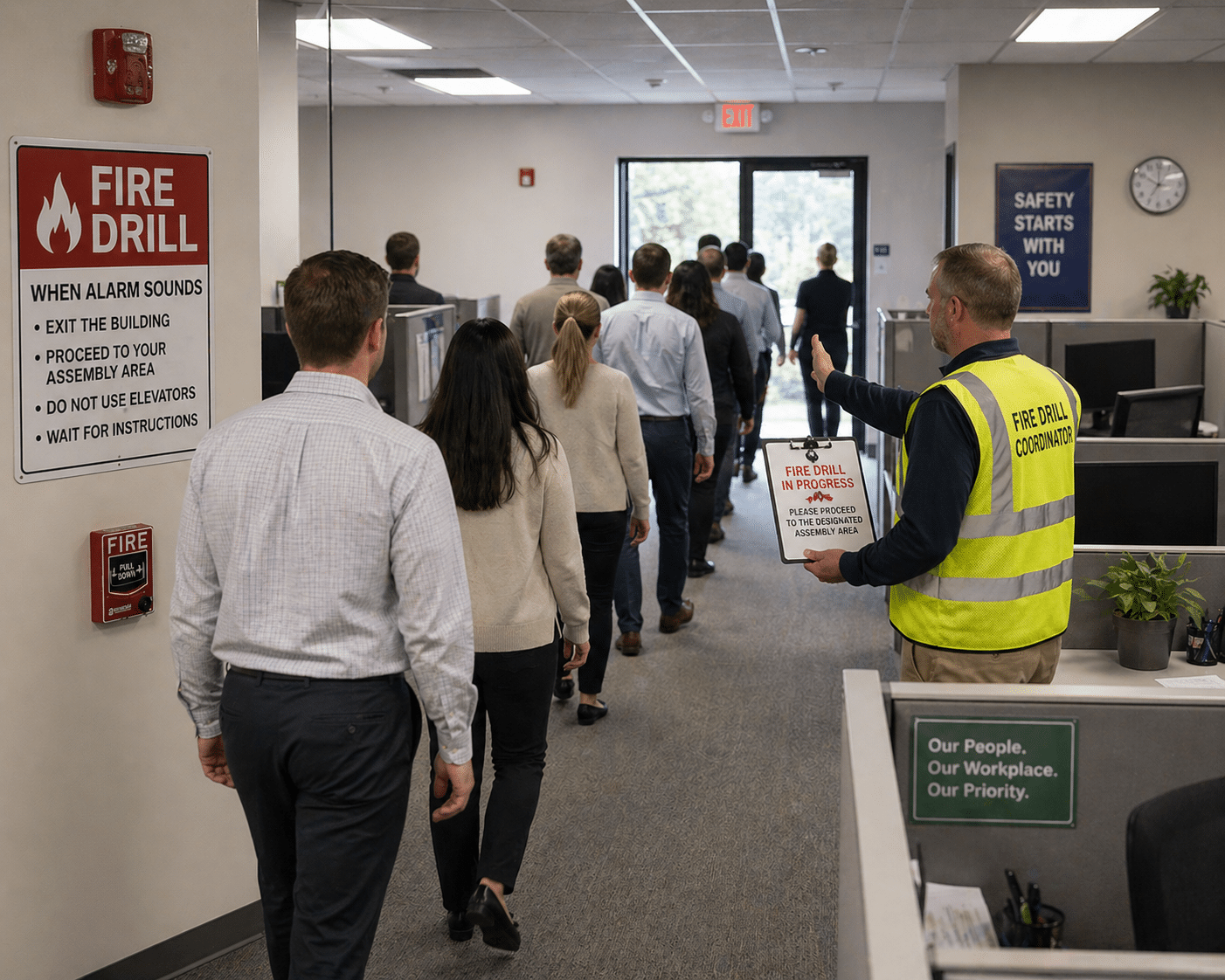
Regular fire drills are one of the simplest, most effective things any organisation can do to protect its people. They cost very little, they take a small amount of time to run, and they can be the difference between a safe, orderly evacuation and a serious incident.
Yet many businesses still treat fire drills as a tick-box exercise. They’re rushed, repeated without variation, or skipped altogether when the calendar gets busy. That’s a problem, because the value of a fire drill comes entirely from how seriously it’s taken.
This guide explains why fire drills matter, what UK law requires, how to run one well, and how often they should be carried out. It’s written for anyone responsible for fire safety in a workplace, school, residential building, or other premises.
Why fire drills matter
In the panic of a real fire, people don’t rise to the occasion, they fall back on what they’ve practised. If they’ve never practised an evacuation, they freeze, hesitate, or follow the wrong instinct. Fire drills give people the muscle memory they need to act quickly when it counts.
They save lives
The single biggest factor in surviving a fire is how quickly people leave the building. A well-rehearsed evacuation can be completed in a fraction of the time of an unpractised one. In a real fire, those minutes are everything.
They identify problems before a real fire does
A fire drill is the only way to test whether your evacuation plan actually works. Drills regularly expose issues that look fine on paper:
- Fire exits that are blocked, locked, or hard to find
- Alarms that can’t be heard in certain parts of the building
- Assembly points that are too close to the building or in unsafe locations
- Staff who don’t know their roles, or fire wardens who haven’t been properly trained
- Visitors, contractors, or new starters who haven’t been briefed
- Vulnerable people who need additional support to evacuate
They reduce panic and confusion
Panic spreads quickly in an emergency, and confusion costs time. People who have practised an evacuation know where to go, who to follow, and what to do if their usual escape route is blocked. They’re far less likely to crowd at a single exit, freeze in place, or rush back into a building to retrieve belongings. A drill replaces uncertainty with a clear, rehearsed response, which keeps everyone calmer and moving.
They build a culture of safety
Regular drills send a clear message that fire safety is taken seriously. They reinforce calm, organised behaviour as the default response to an alarm, rather than the assumption that it’s probably another false alarm.
They’re a legal requirement
In the UK, fire drills aren’t optional. The Regulatory Reform (Fire Safety) Order 2005 places a legal duty on the responsible person for any non-domestic premises to ensure that evacuation procedures are in place and that staff are trained to follow them. In practice, that means running drills.
What UK law requires
The Regulatory Reform (Fire Safety) Order 2005 (the Fire Safety Order) is the main piece of legislation governing fire safety in workplaces and other non-domestic buildings in England and Wales. Similar legislation applies in Scotland (Fire (Scotland) Act 2005) and Northern Ireland (Fire and Rescue Services (Northern Ireland) Order 2006).
Under the Fire Safety Order, the responsible person, usually the employer, building owner, or occupier, must:
- Carry out and regularly review a fire risk assessment
- Implement appropriate fire safety measures
- Provide clear evacuation procedures and routes
- Train staff in fire safety, including how to evacuate
- Keep records of training and drills
There’s no specific frequency for fire drills set out in law, but the broadly accepted standard is at least once a year for most premises, and more often for higher-risk buildings or those with shift workers, frequent staff changes, or a high turnover of occupants.
Failure to comply with the Fire Safety Order is a criminal offence. Penalties range from improvement notices and fines through to imprisonment in the most serious cases, particularly where non-compliance has contributed to a death or serious injury.
Adapting drills to different environments
A fire drill in a small office is a very different exercise from a drill in a hospital, a school, or a high-rise residential building. The principles are the same, but the procedures, risks, and people involved can vary significantly. An effective drill is one that’s been designed around the specific environment it’s testing.
Offices and commercial buildings
Drills focus on quick, orderly evacuation through known escape routes, with attention to visitors and contractors who may not know the building. Sign-in systems and reception staff play a key role.
Schools, colleges, and universities
Drills must keep groups of children or students together and calm. Teachers and staff need to know how to lead pupils out, account for everyone, and manage younger children who may be frightened. Drills should also factor in lessons happening in unusual locations such as labs, gyms, or external buildings.
Healthcare and care homes
Many occupants cannot evacuate independently, so procedures focus on protecting people in place, using compartmentation, and progressive horizontal evacuation rather than full building evacuation. Staff training, Personal Emergency Evacuation Plans (PEEPs), and the use of evacuation chairs are all essential elements of a drill in this environment.
Industrial and warehouse sites
Drills need to account for specific hazards such as machinery, hazardous materials, vehicle traffic, and large open spaces where alarms may be hard to hear. Shift workers should be included in drills planned across different times of day.
Multi-occupancy residential buildings
Drills depend heavily on the building’s evacuation strategy. Some buildings operate a stay-put policy where only the affected flat evacuates, while others use simultaneous evacuation. Both approaches need to be communicated clearly to residents, and drills should be designed to reflect the agreed strategy.
Hospitality, retail, and venues
Members of the public are unfamiliar with the building, so drills focus heavily on staff response — how quickly staff can direct customers to the nearest exit, manage crowd flow, and handle people who don’t initially take the alarm seriously.
How often should fire drills be carried out?
The right frequency depends on the type of building, the number of occupants, and the level of risk. As a general guide:
Low-risk premises (small offices, retail units)
At least one drill per year is the minimum standard. Two per year is good practice.
Higher-risk premises (factories, warehouses, healthcare, hospitality)
Two drills per year as a minimum, with consideration given to running them at different times of day and across different shifts.
Schools, colleges, and universities
At least one drill per term. The first drill of the academic year should take place within the first few weeks so new students learn the procedure.
Care homes and hospitals
At least two drills per year, with additional table-top exercises and staff briefings. The complexity of evacuating people with mobility or cognitive difficulties means this requires more frequent rehearsal.
Multi-occupancy residential buildings
Frequency depends on the building’s evacuation strategy (stay put vs simultaneous evacuation) and should be informed by a fire risk assessment carried out by a competent person.
Whatever the frequency, drills should be varied. Running them at the same time on the same day each year teaches staff to expect them, which defeats the point.
How to run an effective fire drill
1. Plan the drill
Before the drill, agree the scenario. Will it simulate a fire in a specific location? Will a particular escape route be blocked to test alternative routes? Who will observe and record what happens? Brief fire wardens and senior staff in advance, but keep the wider workforce in the dark. A drill that everyone is expecting doesn’t test anything.
2. Activate the alarm
Start the drill by activating the fire alarm exactly as you would in a real fire. Don’t use a verbal announcement instead, the point is to test how people respond to the alarm itself.
3. Observe the evacuation
Designated observers should watch how people respond. Key things to note:
- How quickly people start moving
- Whether anyone ignores the alarm or delays leaving
- Whether escape routes are used correctly
- Whether fire doors are kept closed during evacuation
- How long the full evacuation takes from alarm to all-clear
- Whether everyone reaches the assembly point
- Whether the roll call or sign-in/out system works as intended
4. Conduct a roll call
Once everyone is at the assembly point, account for all staff, visitors, and contractors. This is one of the most commonly overlooked steps and is critical in a real fire. Emergency services need to know whether anyone is unaccounted for.
5. Debrief and document
Immediately after the drill, gather feedback from fire wardens and observers. Note what went well and what didn’t. Record the date, time, scenario, evacuation time, and any issues identified. This record is a legal requirement and forms part of your fire safety documentation.
6. Act on the findings
A drill is only useful if it leads to improvements. Update procedures, fix problems with signage or escape routes, retrain staff where needed, and follow up on any recommendations before the next drill.
Common problems fire drills uncover
Drills consistently reveal the same kinds of issues across different organisations. Watch out for:
- People taking time to gather belongings, finish phone calls, or save work
- Ignoring the alarm because of frequent false alarms
- Confusion about which escape route to use
- Fire doors propped open, blocking their function
- Assembly points that are too small, in the way of emergency vehicles, or unsafe in bad weather
- Visitors and contractors not being included in roll calls
- Vulnerable individuals not having a Personal Emergency Evacuation Plan (PEEP)
- Fire wardens who are unsure of their responsibilities
- New starters who haven’t been briefed during induction
Each of these is fixable, but only if a drill exposes it before a real fire does.
FAQs
Who should take part in a fire drill?
Everyone in the building when the alarm sounds should take part. That means all staff, visitors, contractors, customers, students, residents, and anyone else on site. Sign-in and visitor management systems should make it possible to account for every person, and staff should be trained to direct unfamiliar people to the nearest exit and assembly point. Designated fire wardens, first aiders, and anyone with a specific role during evacuation should know their responsibilities in advance.
How long should a fire drill take?
Most buildings should be able to fully evacuate within 2.5 to 3 minutes. Larger or more complex buildings may take slightly longer. If a drill significantly exceeds this, it usually points to issues with the alarm system, signage, escape routes, or staff awareness.
Do we need to tell staff a drill is happening?
Senior managers, fire wardens, and anyone with a specific role during evacuation should be briefed in advance. The wider workforce shouldn’t be told, the value of a drill comes from testing genuine response to an alarm. However, in some settings (such as schools or care homes), giving general advance notice is appropriate to avoid causing distress.
Should we contact the fire service before a drill?
If your alarm is connected to a monitored alarm receiving centre, yes, let them know in advance so the fire service isn’t dispatched. You don’t usually need to inform the fire service directly unless your local arrangements require it.
What about visitors and contractors?
They must be included. Sign-in systems should make it possible to account for everyone in the building, and visitors should be briefed on the evacuation procedure when they arrive. During a drill, observe whether they actually follow the procedure or look to staff for guidance.
How do we run a drill in a building with people who have mobility issues?
Anyone who may need help evacuating should have a Personal Emergency Evacuation Plan (PEEP). The drill is the opportunity to test that plan and the staff trained to support it. Evacuation chairs, refuge points, and clear communication procedures should all be tested.
What records do we need to keep?
As a minimum, record the date, time, scenario, evacuation time, who participated, what worked well, what didn’t, and any actions arising. Keep these records on file for at least three years, or longer if your insurer or industry guidance requires it.
What if staff refuse to take a drill seriously?
This usually points to a wider cultural issue with fire safety. The response is leadership-led: senior managers should be visibly involved in drills, the importance of fire safety should be reinforced through training, and repeated non-compliance should be addressed through normal HR processes.
Can we be fined for not running fire drills?
Yes. Failure to comply with the Fire Safety Order can result in unlimited fines and, in serious cases, imprisonment. Fire and Rescue Authorities can issue improvement and prohibition notices, and a poor fire safety record significantly increases liability if a fire causes death or injury.
Get expert support from Thameside Fire Protection
Running effective fire drills, maintaining a current fire risk assessment, and keeping your premises compliant with the Fire Safety Order takes time, expertise, and the right systems.
At Thameside Fire Protection we work with businesses, schools, care homes, and residential buildings across the region to deliver fire safety services that go beyond ticking compliance boxes. From fire risk assessments and evacuation planning to alarm testing, fire warden training, and ongoing fire safety management, we make sure the people in your buildings are properly protected.
Get in touch with Thameside Fire Protection today to book a fire risk assessment, arrange fire warden training, or talk through how we can support your fire safety obligations.