
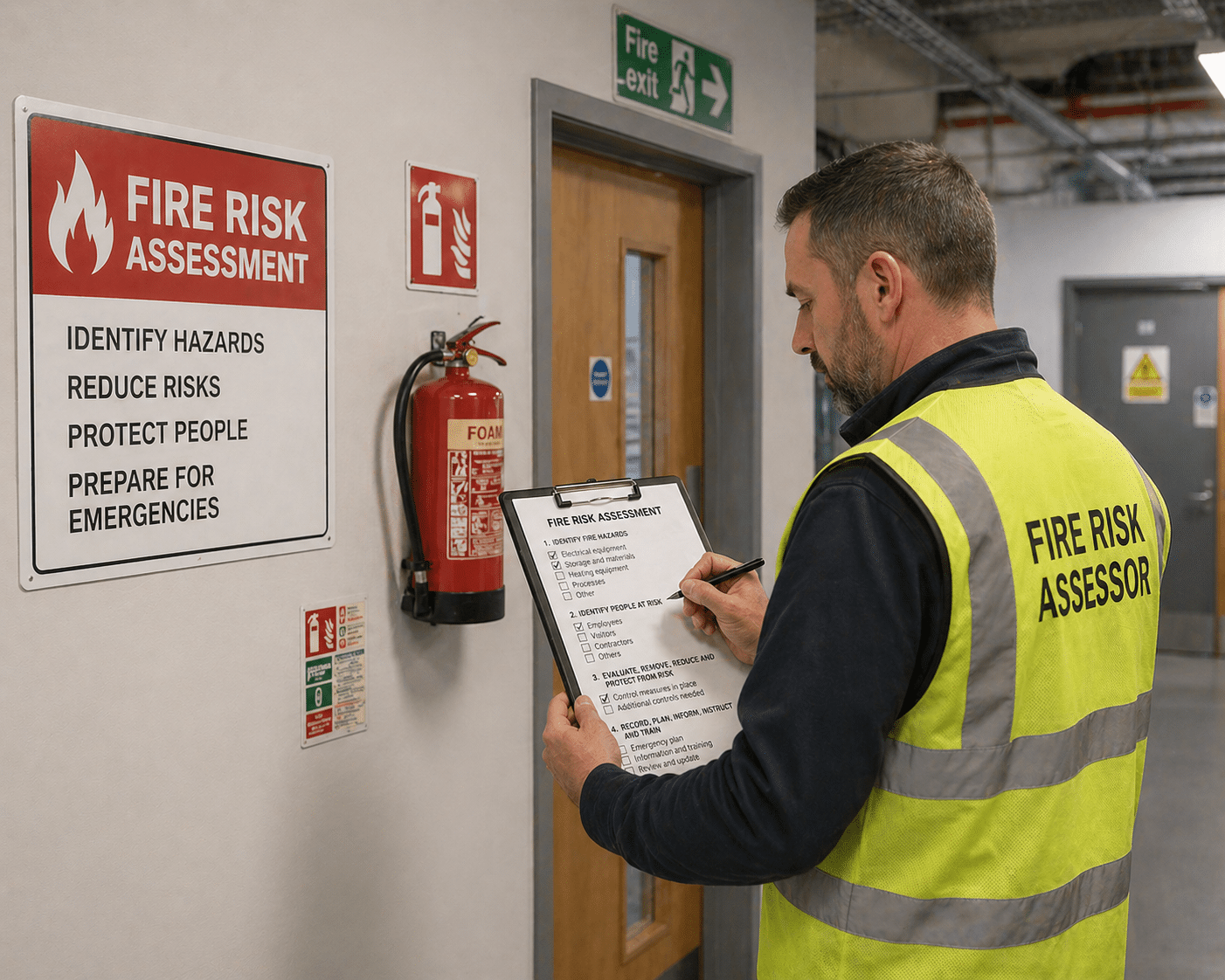
A fire risk assessment is one of the most fundamental responsibilities a business or building owner can fulfil. Far from being a bureaucratic formality, it is a systematic process that can mean the difference between a minor incident and a catastrophic loss of life or property.
What is a fire risk assessment?
A fire risk assessment is a structured evaluation of a premises to identify potential fire hazards, assess who may be at risk, and determine what measures need to be in place to reduce that risk to an acceptable level. It covers everything from the storage of flammable materials and the condition of electrical equipment to the adequacy of escape routes and the suitability of fire detection systems.
Who is legally required to have one?
Under the Regulatory Reform (Fire Safety) Order 2005, any non-domestic premises in England and Wales must have a fire risk assessment carried out and kept up to date. This includes offices, warehouses, shops, restaurants, schools, care homes and shared areas of residential buildings. The responsible person, typically the employer, building owner or managing agent, is legally obligated to ensure this is done and that findings are acted upon.
Failure to comply can result in enforcement notices, prohibition of use, unlimited fines and in serious cases, prosecution and imprisonment.
Why regular assessments matter
A fire risk assessment is not a one-off exercise. Buildings change, new equipment is introduced, layouts are altered, occupancy levels shift, and staff come and go. Each of these changes can introduce new risks or render previously adequate precautions insufficient. Regular reassessment ensures that fire safety measures keep pace with the reality of how a building is actually being used.
There is no fixed legal interval for reassessment, but as a general rule assessments should be reviewed annually, or sooner if there has been a significant change to the premises, a fire or near-miss, or a reason to believe the current assessment is no longer valid.
The human cost of getting it wrong
Statistics from the National Fire Chiefs Council consistently show that the majority of fire fatalities occur in premises where fire safety measures were inadequate or not properly maintained. Early detection, clear escape routes and staff who know what to do in an emergency are not accidental, they are the direct result of a thorough risk assessment being taken seriously.
Beyond the human cost, a serious fire can devastate a business. The combination of property damage, business interruption, legal liability and reputational harm means that many businesses never fully recover from a major fire incident.
Getting it right
While smaller, lower-risk premises may be able to carry out a competent assessment in-house, most businesses benefit from engaging a qualified fire risk assessor. A professional assessment provides not only an objective evaluation of risk but also documented evidence that the responsible person has fulfilled their legal duty which matters significantly in the event of an incident or inspection.
A good fire risk assessor will not simply produce a report and move on. They will work with you to understand your building, your operations and your people, and provide practical recommendations that are proportionate to the actual level of risk.
Fire risk assessments exist because fires are preventable. The vast majority of serious fire incidents are preceded by identifiable hazards that were either not spotted or not acted upon. A thorough, up-to-date assessment is the foundation of any serious approach to fire safety, not just because the law requires it, but because the people who work in and visit your building deserve nothing less.
FAQs
How often should a fire risk assessment be carried out?
There is no single legally prescribed interval, but annual reviews are widely considered best practice. You should also carry out a reassessment whenever there has been a significant change to the premises such as a refurbishment, a change in occupancy, the introduction of new equipment or processes, or following a fire or near-miss incident.
Who can carry out a fire risk assessment?
The law requires that the person carrying out the assessment is competent to do so, meaning they have sufficient training, experience and knowledge of fire safety to identify hazards and evaluate risks accurately. For most commercial premises, engaging a qualified and accredited fire risk assessor is the safest and most defensible approach.
What happens if I don’t have a fire risk assessment?
If you are the responsible person for a non-domestic premises and do not have a suitable and sufficient fire risk assessment in place, you are in breach of the Regulatory Reform (Fire Safety) Order 2005. This can result in enforcement action from your local Fire and Rescue Service, including improvement notices, prohibition notices that prevent use of the premises, and in serious cases, prosecution leading to unlimited fines or imprisonment.
Does a fire risk assessment need to be written down?
If your business employs five or more people, you are legally required to record the significant findings of your fire risk assessment in writing. Even if you are below that threshold, a written record is strongly advisable, it demonstrates due diligence and provides clear evidence that your legal duty has been fulfilled.
What does a fire risk assessment cover?
A thorough assessment will identify potential ignition sources, fuels and materials that could contribute to a fire, and people who may be at risk including employees, visitors and anyone who may have difficulty evacuating. It will evaluate existing fire safety measures such as detection systems, alarm systems, extinguishers, emergency lighting and escape routes, and identify any areas where improvements are needed.
How long does a fire risk assessment take?
This depends on the size, complexity and use of the premises. A small, straightforward office might be assessed in a couple of hours, while a large or high-risk premises such as a care home, hotel or industrial facility may require significantly more time. A qualified assessor will be able to give you an accurate estimate once they understand the scope of the premises.
Get a professional fire risk assessment from Thameside Fire Protection
At Thameside Fire Protection we provide expert fire risk assessments for businesses across a wide range of sectors. Our qualified assessors combine in-depth knowledge of fire safety legislation with practical, hands-on experience, giving you a clear picture of your risk and the steps needed to address it.
Whether you need an initial assessment, a review of an existing one, or ongoing fire safety support, we can help. We work with you directly, not around you, producing reports that are clear, actionable and properly documented.