
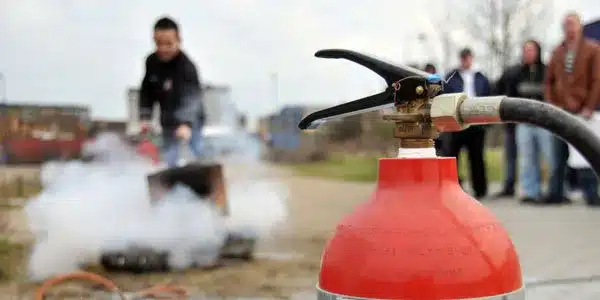
Knowing how to use a fire extinguisher correctly could be the difference between a small incident and a serious fire. Whether you’re a business owner, a designated fire warden, or simply someone who wants to be prepared at home, understanding the right technique, and when not to use an extinguisher, is essential.
This guide covers the PASS technique, the different types of fire extinguisher and when to use each one, key safety considerations, and answers to the most common questions we get asked during our fire safety training courses.
Before you use a fire extinguisher
Before reaching for an extinguisher, you need to make a quick assessment. A fire extinguisher is only suitable for small, early-stage fires. If the fire has spread beyond its point of origin, if the room is filling with smoke, or if you have any doubt about whether you can tackle it safely, evacuate immediately and call 999.
If you do decide to act, keep these things in mind:
- Alert others first. Sound the fire alarm and make sure the building evacuation is underway before attempting to fight the fire yourself.
- Keep your back to an exit. Always position yourself so you have a clear escape route behind you. If the fire grows or the extinguisher runs out, you need to be able to leave immediately.
- Check you have the right extinguisher. Using the wrong type of extinguisher on certain fires can make the situation worse — and in some cases, it can be dangerous. More on this below.
- Never return to a fire. If you’ve used an extinguisher and the fire reignites or continues to grow, leave the building and wait for the fire service.
The PASS technique
The PASS technique is the standard method for operating a fire extinguisher. It stands for Pull, Aim, Squeeze, Sweep – four steps designed to be simple enough to remember under pressure.
Pull the pin
Every fire extinguisher has a safety pin at the top, near the handle, that prevents accidental discharge. Pull the pin out with a firm twisting motion to break the tamper seal. Once the pin is removed, the handle is live and ready to use. At this point, give the extinguisher a quick test burst aimed away from you to make sure it’s working and to get a feel for the range and force of the spray.
Aim at the base of the fire
Point the nozzle, hose, or horn at the base of the fire not at the flames. This is one of the most common mistakes people make. The flames are the visible part of the fire, but the source of the burning is at the base where the fuel meets the heat. Aiming at the flames will send the extinguishing agent straight over the top of the fire without tackling the source.
Stand at a safe distance. Most extinguishers have an effective range of around 2 to 4 metres, though this varies by type and size.
Squeeze the handle
Squeeze the handles together with firm, even pressure to discharge the extinguishing agent. Avoid squeezing too hard or in short bursts, a steady, controlled discharge is more effective. Bear in mind that most standard fire extinguishers will empty completely in around 10 to 20 seconds, so you need to make every second count.
Sweep from side to side
With the nozzle still aimed at the base, sweep the extinguisher from side to side in a controlled motion, covering the full width of the fire. As the flames reduce, you can gradually move closer but stay alert and keep your escape route behind you at all times. Once the fire appears to be out, watch the area carefully for several minutes. Fires can reignite, particularly with flammable liquids or deep-seated materials.
Common mistakes when using a fire extinguisher
Even people who know the PASS technique can make mistakes under pressure. These are the most common errors we see during training:
- Aiming at the flames instead of the base. This wastes the extinguishing agent and doesn’t tackle the source of the fire.
- Standing too close. Getting too near to the fire before starting to discharge the extinguisher puts you at risk from heat, smoke, and sudden flare-ups.
- Using the wrong type of extinguisher. In particular, using water on electrical fires or cooking oil fires can be extremely dangerous.
- Forgetting to pull the pin. Under pressure, people sometimes squeeze the handles without removing the safety pin first – nothing happens, and they lose valuable seconds.
- Turning your back on the fire. Always keep your escape route behind you. Never let the fire get between you and the exit.
- Walking away too soon. A fire that looks extinguished can reignite. Watch the area for several minutes before considering it safe.
When not to use a fire extinguisher
A fire extinguisher is designed for small, early-stage fires only. You should not attempt to use one if:
- The fire has spread beyond its point of origin or is growing rapidly
- The room is filling with smoke and visibility is poor
- You don’t know what type of fire it is or which extinguisher to use
- You haven’t been trained in fire extinguisher use
- Your escape route is compromised or could become blocked
- The fire involves hazardous materials you’re not equipped to deal with
In any of these situations, the safest course of action is to evacuate the building, close doors behind you to slow the spread of fire, and call 999.
Fire extinguisher maintenance and legal requirements
In the UK, the Regulatory Reform (Fire Safety) Order 2005 requires the “responsible person” (typically the business owner, employer, or landlord) to ensure that fire extinguishers are properly maintained and in working order.
This includes:
- Annual servicing by a competent person, in line with BS 5306-3
- Monthly visual checks to ensure extinguishers are in their designated location, the pressure gauge is in the green zone, the pin and tamper seal are intact, and there’s no visible damage or corrosion
- Extended servicing at set intervals depending on the type of extinguisher (typically every 5 years for water, foam, and wet chemical; every 10 years for CO2)
- Replacement when an extinguisher has reached the end of its service life or fails an inspection
Thameside Fire Protection provides fire extinguisher servicing, maintenance, and supply across the UK. We carry out annual inspections to BS 5306-3, install new extinguishers where needed, and ensure your business stays compliant with fire safety legislation.
Frequently asked questions
What does PASS stand for in fire safety?
PASS stands for Pull, Aim, Squeeze, Sweep. It’s the standard technique for using a portable fire extinguisher. Pull the safety pin, aim the nozzle at the base of the fire, squeeze the handles to discharge the agent, and sweep from side to side until the fire is out.
How long does a fire extinguisher last when you use it?
Most standard fire extinguishers will discharge their full contents in around 10 to 20 seconds, depending on the type and size. This is why technique matters, you need to be accurate and efficient with the limited time you have.
Can I use a fire extinguisher without training?
In an emergency, anyone can use a fire extinguisher. However, hands-on training significantly improves your effectiveness and confidence under pressure. In the workplace, the Regulatory Reform (Fire Safety) Order 2005 requires that employees designated to use fire extinguishers must receive appropriate training. Thameside offers fire extinguisher training courses for businesses across Essex and the South East.
What happens if you use the wrong fire extinguisher?
Using the wrong extinguisher can be ineffective at best and dangerous at worst. For example, using a water extinguisher on a cooking oil fire can cause the burning oil to erupt and spread rapidly. Using water on an electrical fire risks electrocution. Always check the extinguisher label before use.
How often should fire extinguishers be serviced?
Fire extinguishers require an annual service by a competent person in accordance with BS 5306-3, plus monthly visual inspections carried out by someone on-site. Extended servicing is required at set intervals depending on the extinguisher type. Thameside provides annual servicing and maintenance to keep your extinguishers compliant and in working order.
How many fire extinguishers do I need in my building?
The number and type of extinguishers required depends on the size of your premises, the fire risks present, and the findings of your fire risk assessment. As a general guideline, you need a minimum of two Class A extinguishers per floor, plus additional extinguishers appropriate to specific risks (such as CO2 near electrical equipment or wet chemical in a commercial kitchen). A fire risk assessment will identify exactly what you need.
Where should fire extinguishers be placed?
Fire extinguishers should be mounted on wall brackets or placed on stands in clearly visible, easily accessible locations, ideally near exits and along escape routes. They should be sited at a consistent height (the handle approximately 1 metre from the floor) and should not be obstructed by furniture, equipment, or stored materials.
Can fire extinguishers be reused after discharge?
No. Once a fire extinguisher has been discharged, even partially, it must be serviced, recharged, or replaced before it can be relied upon again. Never put a used extinguisher back on the wall without having it professionally inspected and refilled.
What is the safe distance to use a fire extinguisher from?
Most fire extinguishers have an effective range of approximately 2 to 4 metres, though this varies depending on the type and size of the extinguisher. Start at the maximum range, test the reach with a short burst, and move closer gradually as the fire reduces, always keeping your back to an exit.
Do fire extinguishers expire?
Fire extinguishers don’t have a fixed expiry date in the way food does, but they do have a finite service life. With proper annual servicing and extended maintenance at the required intervals, most extinguishers can remain in service for many years. However, they should be replaced if they fail an inspection, show signs of corrosion or damage, or cannot be recharged to the required standard.
Fire extinguisher training and servicing
Understanding how to use a fire extinguisher is one part of being prepared. Making sure your extinguishers are properly maintained, correctly positioned, and appropriate for the risks in your building is the other.
Thameside Fire Protection provides:
- Fire extinguisher supply, installation, and servicing – annual inspections to BS 5306-3, new installations, and replacement of end-of-life units
- Fire safety training courses – including hands-on fire extinguisher training, fire warden training, and fire awareness courses for your team
- Fire risk assessments – to identify the risks in your premises and ensure you have the right protection in place
We work with businesses across the UK. To find out more or to book a service, get in touch or call us on 0800 975 4888.