
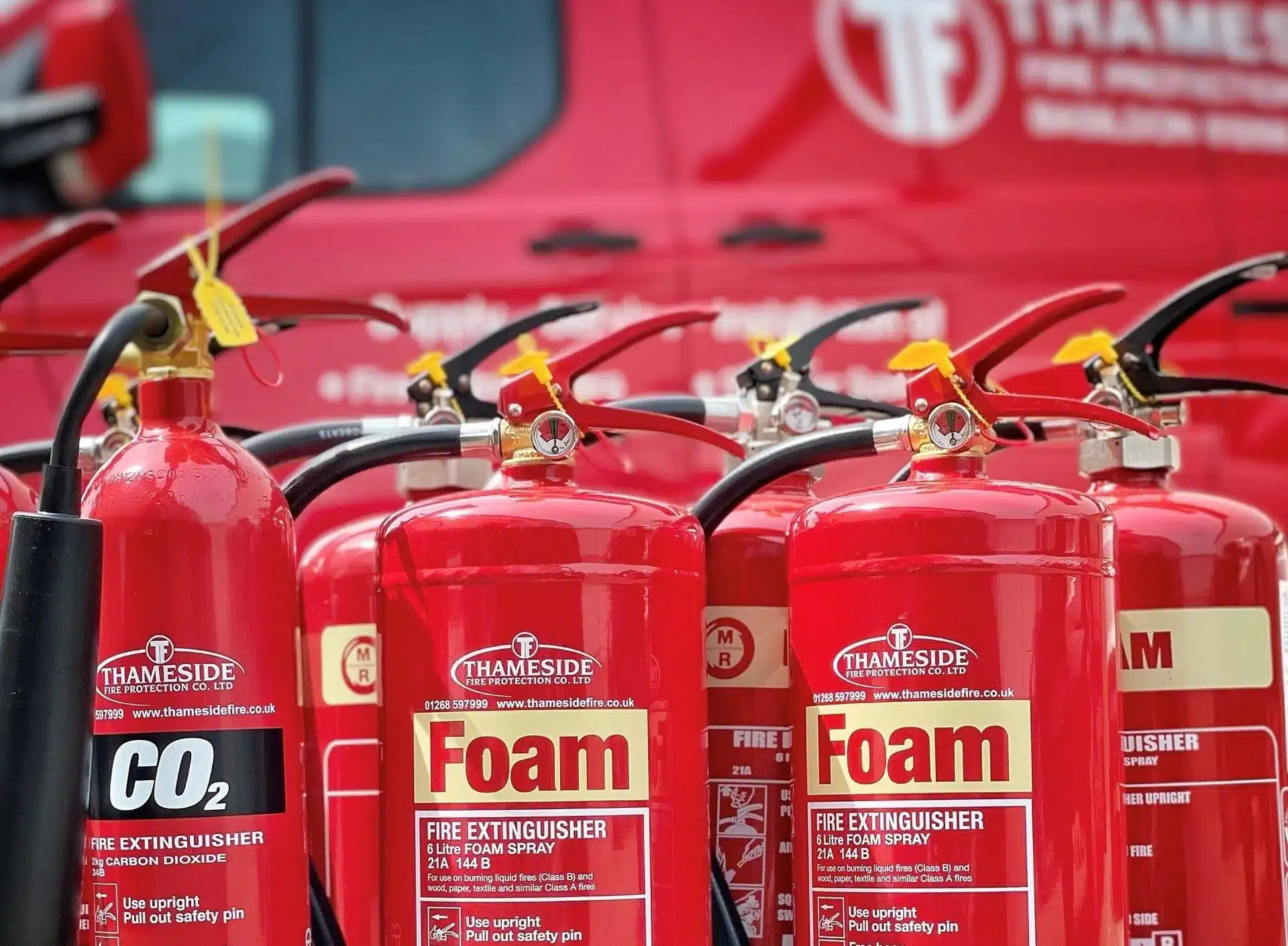
Having the right fire extinguishers for your business or commercial property is essential for protecting your premises, your employees, and ensuring you comply with current fire safety regulations. In an emergency situation involving fire, it’s important to understand which extinguisher type to use so you can respond quickly and appropriately – and only if the fire is small, manageable, and your escape route is clear.
There are different types of fire extinguishers designed to tackle specific classes of fire. Below is an overview of the main types of fire extinguisher, what they can be used on, and what they should never be used for.
Water Fire Extinguishers
Water fire extinguishers are the most common type and are designed for Class A fires. They work by cooling the burning material, reducing the temperature until the flames are extinguished.
Label Colour
Red
Suitable For
- Paper and cardboard
- Fabrics and textiles
- Wood and coal
Do Not Use For
- Electrical fires
- Flammable liquids
- Flammable gases
- Kitchen or cooking oil fires
Foam Fire Extinguishers
Foam fire extinguishers are water-based and are primarily used for Class B fires involving flammable liquids, but they are also effective on Class A fires. They work by forming a barrier between the flame and the fuel source, while also providing a cooling effect.
Label Colour
Red with cream label
Suitable For
- Paper and cardboard
- Fabrics and textiles
- Wood and coal
- Flammable liquids such as petrol or diesel
Do Not Use For
- Electrical fires
- Flammable gases
- Kitchen or cooking oil fires
CO2 Fire Extinguishers
CO2 fire extinguishers are designed for Class B fires and are particularly effective on live electrical equipment. They work by displacing oxygen and suffocating the fire. These extinguishers do not leave residue, making them ideal for environments with sensitive equipment.
Label Colour
Red with black label
Suitable For
- Flammable liquids
- Live electrical equipment
Do Not Use For
- Wood, paper, or textiles
- Flammable metal fires
- Confined or enclosed spaces
Dry Powder Fire Extinguishers
Often referred to as ABC extinguishers, dry powder fire extinguishers are extremely versatile. They can be used on Class A, B, and C fires, as well as on live electrical equipment. However, they are not suitable for use in enclosed spaces due to the inhalation risk and residue left behind.
Label Colour
Red with blue label
Suitable For
- Paper and cardboard
- Fabrics and textiles
- Wood and coal
- Flammable liquids such as paint or petrol
- Flammable gases such as LPG or acetylene
- Electrical equipment up to 1000v
Do Not Use For
- Electrical equipment over 1000v
- Cooking oil fires
- Fires in enclosed spaces such as offices or residential buildings
Wet Chemical Fire Extinguishers
Wet chemical fire extinguishers are designed specifically for Class F fires involving cooking oils and fats. Some wet chemical extinguishers are also suitable for limited Class A fires. They should be discharged from a distance of at least one metre, using the entire contents of the extinguisher.
Suitable For
- Cooking oil and fat fires
- Some Class A fires (check manufacturer guidance)
How to Operate a Fire Extinguisher
Fire extinguishers should be operated using the PASS method:
- Pull the pin to break the seal and test away from the body
- Aim the nozzle at the base of the fire
- Squeeze the handles together
- Sweep from side to side at the base of the flames
Fire Extinguishers and Training from Thameside Fire Protection
At Thameside Fire Protection, we supply, install, service, and maintain fire extinguishers of all types. We also offer expert advice on correct usage, alongside a full range of fire protection services including fire alarm installation, fire risk assessments, and fire safety training.
If you’re looking to ensure your premises are compliant and your staff are confident in emergency situations, get in touch today.