
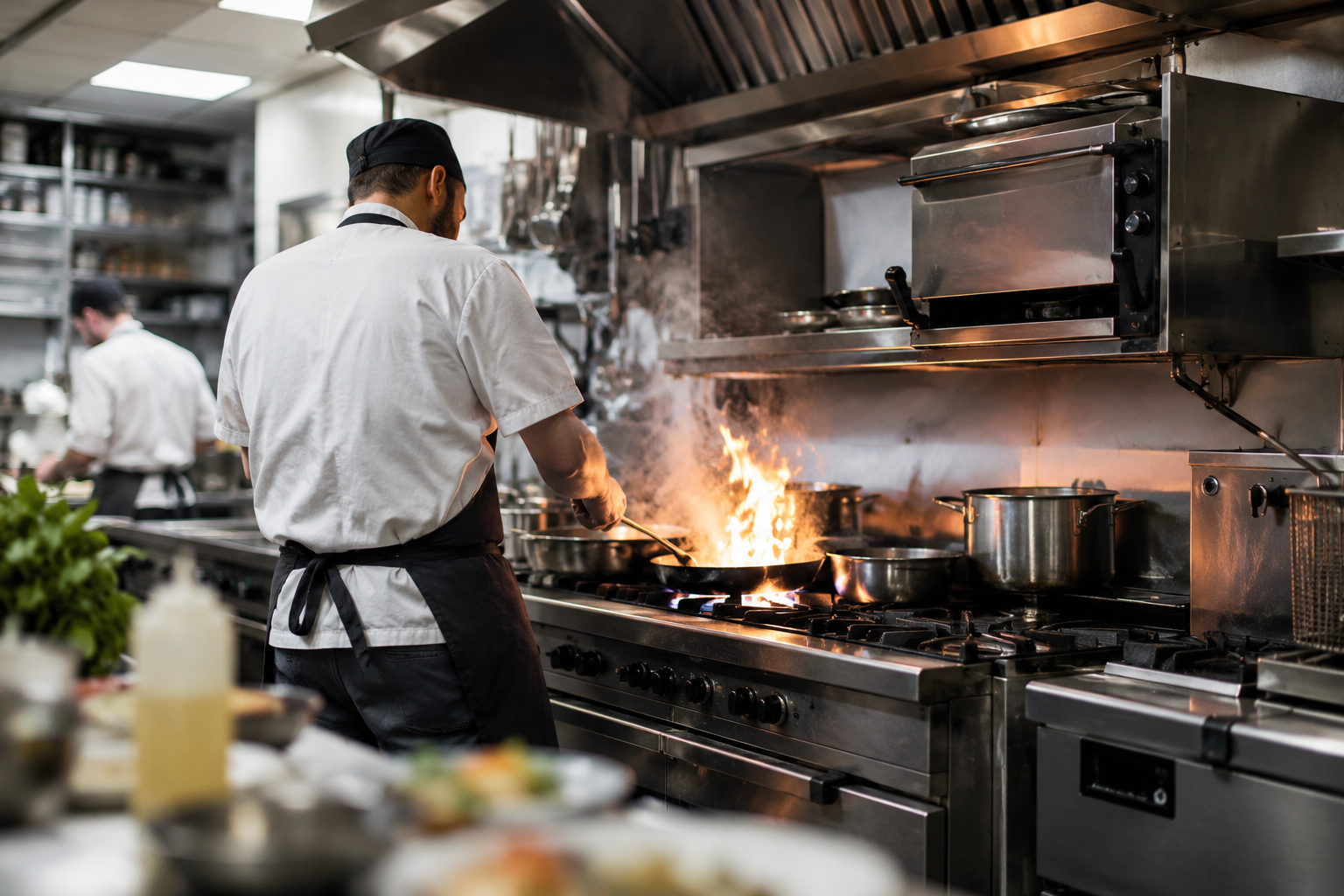
Commercial kitchen fires can be prevented by controlling common fire risks, maintaining cooking and extraction equipment, following safe working practices and ensuring appropriate fire detection and protection systems are in place. Restaurants, pubs, hotels, takeaways and other commercial kitchens face particular fire risks because high temperatures, electrical equipment and large quantities of cooking oils and fats are part of everyday operations.
This guide explains the practical steps businesses can take to prevent fires in commercial kitchens, from cleaning and maintenance to staff training, fire extinguishers and dedicated kitchen fire suppression systems.
What Causes Fires in Commercial Kitchens?
Understanding where fires are most likely to start can help you put appropriate preventative measures in place.
The main causes of fire in commercial kitchens and hospitality environments include:
- Unattended cooking
- Overheated cooking oils and fats
- Grease accumulating on cooking and extraction equipment
- Faulty or poorly maintained electrical equipment
- Combustible materials being stored too close to heat sources
- Human error and unsafe working practices
Commercial kitchens are particularly high-risk environments because open flames, hot surfaces and cooking oils are frequently combined with fast-paced working conditions. Thameside’s guide to the common causes of fire in the hospitality industry explores these risks in more detail.
Once those risks have been identified, the focus should be on reducing the likelihood that they result in a fire.
Keep Cooking Equipment Clean and Well Maintained
Regular cleaning and maintenance are among the most important ways to prevent fires in a commercial kitchen.
Grease, cooking oil and food debris can accumulate on ovens, grills, hobs, fryers and surrounding surfaces. If allowed to build up, these deposits can provide additional fuel if a fire starts.
Establish a documented cleaning schedule appropriate to how frequently each area and piece of equipment is used. High-volume kitchens may require significantly more frequent cleaning than premises where cooking takes place occasionally.
Cooking equipment should also be maintained according to the manufacturer’s recommendations. Faults should be reported and investigated promptly rather than allowing damaged or malfunctioning equipment to remain in service.
Regularly Clean Extraction and Ventilation Systems
Cleaning shouldn’t stop with the visible areas of the kitchen.
Grease-laden vapour produced during cooking is drawn into extraction canopies, filters and ductwork, where deposits can accumulate over time. If a fire reaches contaminated extraction equipment, these deposits can contribute to it spreading beyond the immediate cooking area and into other parts of the building.
Commercial kitchens should therefore have an appropriate inspection and cleaning regime covering the complete extraction system, not simply the visible hood and filters.
The required frequency will depend on factors including the type of cooking undertaken and how heavily the kitchen is used. Professional cleaning should be carried out where required, with appropriate records retained.
Never Leave High-Risk Cooking Unattended
Cooking involving high temperatures requires appropriate supervision, particularly when oils and fats are involved.
This can become more difficult during busy service periods, so responsibilities should be clear. Staff working on individual stations should understand which equipment they’re responsible for monitoring rather than assuming somebody else is keeping an eye on it.
Deep-fat fryers require particular attention because oil can ignite if it becomes sufficiently hot. Thermostats, temperature controls and other safety mechanisms should therefore be kept in good working order.
Water should never be used to tackle a fire involving burning cooking oil or fat.
Store Cooking Oils and Combustible Materials Safely
Commercial kitchens can contain significant quantities of cooking oil alongside cardboard packaging, cloths, paper products and other combustible materials.
These should be stored appropriately and kept away from potential ignition sources.
Good housekeeping should continue during busy periods. Packaging, waste and other combustible materials shouldn’t be allowed to accumulate around ovens, grills, fryers or other hot equipment simply because the kitchen is in the middle of service.
Used cooking oil should also be handled and stored safely according to the procedures appropriate for the premises.
Check Electrical and Gas Equipment Regularly
Commercial cooking equipment should be correctly installed, inspected and maintained.
Staff should also be encouraged to report potential problems immediately rather than continuing to use equipment that could be unsafe.
Warning signs could include:
- Damaged cables or plugs
- Burning smells
- Sparks
- Excessive heat
- Unusual flames
- Equipment repeatedly cutting out
- Electrical circuits repeatedly tripping
Where specialist inspection, servicing or repair is required, this should be carried out by a suitably competent person.
Make Fire Safety Part of Kitchen Closing Procedures
A defined closing procedure can reduce the likelihood of fire risks being overlooked at the end of a shift.
Depending on the kitchen, closing checks could include making sure:
- Cooking appliances have been safely switched off
- Fryers and other high-risk equipment have been left in a safe condition
- Combustible waste has been removed
- Flammable materials have been appropriately stored
- Cooking areas have been cleaned
- Fire exits and escape routes remain unobstructed
- Equipment faults have been reported
Assigning responsibility for these checks makes them less likely to be missed during a busy close-down.
Install Appropriate Fire Detection
Early detection can provide vital additional time for staff, customers and other occupants to evacuate if a fire occurs.
Commercial kitchens can present particular challenges for fire detection because normal cooking produces heat, steam and fumes. Fire detection therefore needs to be selected and positioned appropriately for the environment while forming part of the premises’ wider fire alarm system.
The appropriate solution will depend on the building, kitchen layout, occupancy and findings of the fire risk assessment.
Fire alarm systems should also be regularly tested, inspected and maintained to ensure they remain ready to operate when required.
Use the Correct Fire Extinguishers for a Commercial Kitchen
Commercial kitchens can contain several different types of fire risk, which means there isn’t a single fire extinguisher that’s suitable for every potential incident.
Cooking oils and fats require a different approach from fires involving electrical equipment, while combustible materials such as cardboard, paper and textiles introduce another type of risk. The different types of fire extinguishers are designed for specific classes of fire, so using the wrong one may be ineffective and, in some circumstances, can make a fire considerably more dangerous.
The extinguishers provided should therefore be selected according to the specific risks identified within the premises and its fire risk assessment.
Wet Chemical Fire Extinguishers for Cooking Oils and Fats
Fires involving cooking oils and fats are classified as Class F fires and require particular care.
Wet chemical extinguishers are specifically designed for this type of fire, making them particularly relevant to commercial kitchens using deep-fat fryers and other equipment containing significant quantities of cooking oil.
Water should never be used on a cooking oil fire. Other extinguisher types may also be unsuitable, which is why staff need to understand the equipment provided and the types of fire it is designed to tackle.
Other Fire Extinguishers in Commercial Kitchens
Class F fires aren’t necessarily the only fire risk within a commercial kitchen or the wider premises.
Depending on the hazards identified, businesses may also require:
- Water extinguishers for Class A fires involving combustible materials such as paper, cardboard, wood and some textiles.
- Foam extinguishers for Class A fires and Class B fires involving flammable liquids.
- CO2 extinguishers for fires involving live electrical equipment.
- Dry powder extinguishers for certain Class A, B and C risks, although they aren’t suitable for cooking oil fires and may be inappropriate for some enclosed environments.
The appropriate combination will depend on the individual premises. A restaurant, for example, may need wet chemical protection around its cooking equipment alongside different extinguishers elsewhere in the building.
Make Sure Fire Extinguishers Are Correctly Positioned and Maintained
Choosing the right extinguishers is only part of effective fire protection. They also need to be appropriately positioned, clearly identifiable and regularly inspected and maintained so they’re ready to use in an emergency.
Professional fire extinguisher services can help ensure the correct types and quantities are provided for the risks within the premises, as well as covering installation, commissioning and ongoing servicing and maintenance.
Staff who may be expected to use an extinguisher should also understand which equipment is appropriate for different types of fire and how to use it safely. They should never put themselves at unnecessary risk attempting to tackle a fire.
Fire Blankets
Fire blankets may also form part of the firefighting equipment provided within a commercial kitchen. They should be appropriately positioned and staff should understand when and how they’re intended to be used.
If a fire can’t be dealt with safely, the priority should always be to raise the alarm, evacuate and call the fire and rescue service.
Consider a Commercial Kitchen Fire Suppression System
For higher-risk commercial kitchens, portable fire extinguishers may form only one part of the protection required.
A commercial kitchen fire suppression system, sometimes referred to as a cooker-hood suppression system, provides dedicated protection for the cooking media within a commercial kitchen environment. Fire suppression systems can automatically detect and respond to a developing fire, helping to control or extinguish it before it spreads further.
This can be particularly valuable around high-risk cooking equipment and extraction areas.
The appropriate suppression system will depend on factors including:
- Kitchen layout
- Cooking appliances
- Extraction equipment
- Cooking methods
- Identified fire hazards
- The wider fire protection strategy for the premises
Thameside Fire Protection designs, supplies, installs, commissions and services fire suppression systems for commercial kitchens and other high-risk environments. Its engineers assess the individual environment before recommending an appropriate solution.
Suppression systems also require ongoing maintenance. Planned servicing and inspections help ensure the system remains reliable and ready to operate in the event of a fire.
Train Kitchen Staff in Fire Safety
Fire prevention depends on the people working in the kitchen as well as the equipment installed within it.
Staff should understand the fire hazards associated with their role and the procedures designed to control them.
Training should cover areas such as:
- Safe use of cooking equipment
- Good housekeeping and cleaning
- Reporting damaged or malfunctioning equipment
- Raising the alarm
- Evacuation procedures
- The location of firefighting equipment
- When firefighting equipment should and shouldn’t be used
Staff expected to use fire extinguishers should also receive appropriate instruction and training.
Regular refresher training can help prevent safe practices from becoming less consistent over time.
Keep Fire Exits and Escape Routes Clear
A commercial kitchen fire can develop quickly, so everyone working in or around the kitchen needs to be able to evacuate safely.
Escape routes and fire exits should remain unobstructed at all times. Deliveries, bins, packaging, stock and kitchen equipment shouldn’t be stored where they could impede an evacuation.
Fire doors also play an important role in limiting the movement of fire and smoke through a building and shouldn’t be routinely wedged open.
Staff should understand the premises’ evacuation procedure and know where they’re expected to go once they’ve left the building.
Carry Out and Regularly Review Your Fire Risk Assessment
Commercial kitchen fire safety should form part of the premises’ wider fire risk assessment.
For non-domestic premises in England and Wales, the responsible person must carry out and keep up to date a suitable and sufficient fire risk assessment and act on its findings. Restaurants and other hospitality premises are included within these requirements.
Within a commercial kitchen, the assessment should consider factors such as:
- Cooking equipment and methods
- Oils and fats
- Extraction systems
- Gas and electrical equipment
- Combustible materials
- Cleaning procedures
- Fire detection and alarms
- Fire extinguishers
- Fire suppression systems
- Staff training
- Fire doors and escape routes
- People who may be particularly at risk
The assessment should also be reviewed when significant changes are made to the kitchen, such as installing new equipment or changing its layout or use.
What Should Staff Do if a Commercial Kitchen Fire Starts?
Prevention should always be the priority, but staff also need to understand what to do if a fire occurs.
Employees should follow the premises’ established emergency procedures, raise the alarm and evacuate when necessary.
Never use water on burning cooking oil or fat. Staff should also avoid attempting to move a burning pan, fryer or container.
Firefighting equipment should only be used when it is appropriate for the fire, the person understands how to use it safely and there remains a clear means of escape.
If the fire cannot be dealt with safely, evacuate the premises, call 999 and leave firefighting to the fire and rescue service.
Protect Your Commercial Kitchen With Thameside Fire Protection
Preventing commercial kitchen fires requires a combination of safe working practices, effective staff training and fire protection measures designed around the specific risks within your premises.
With more than 40 years of experience in commercial fire protection, Thameside Fire Protection provides businesses across the UK with a comprehensive range of fire safety services, including fire extinguishers, fire alarms, fire suppression systems, fire risk assessments and workplace fire safety training.
For commercial kitchens, Thameside can design, install, commission and maintain dedicated kitchen and cooker-hood fire suppression systems, with solutions tailored to the environment and the particular fire risks being protected.
Contact Thameside Fire Protection to discuss your commercial kitchen fire safety requirements and find the right fire protection solution for your premises.